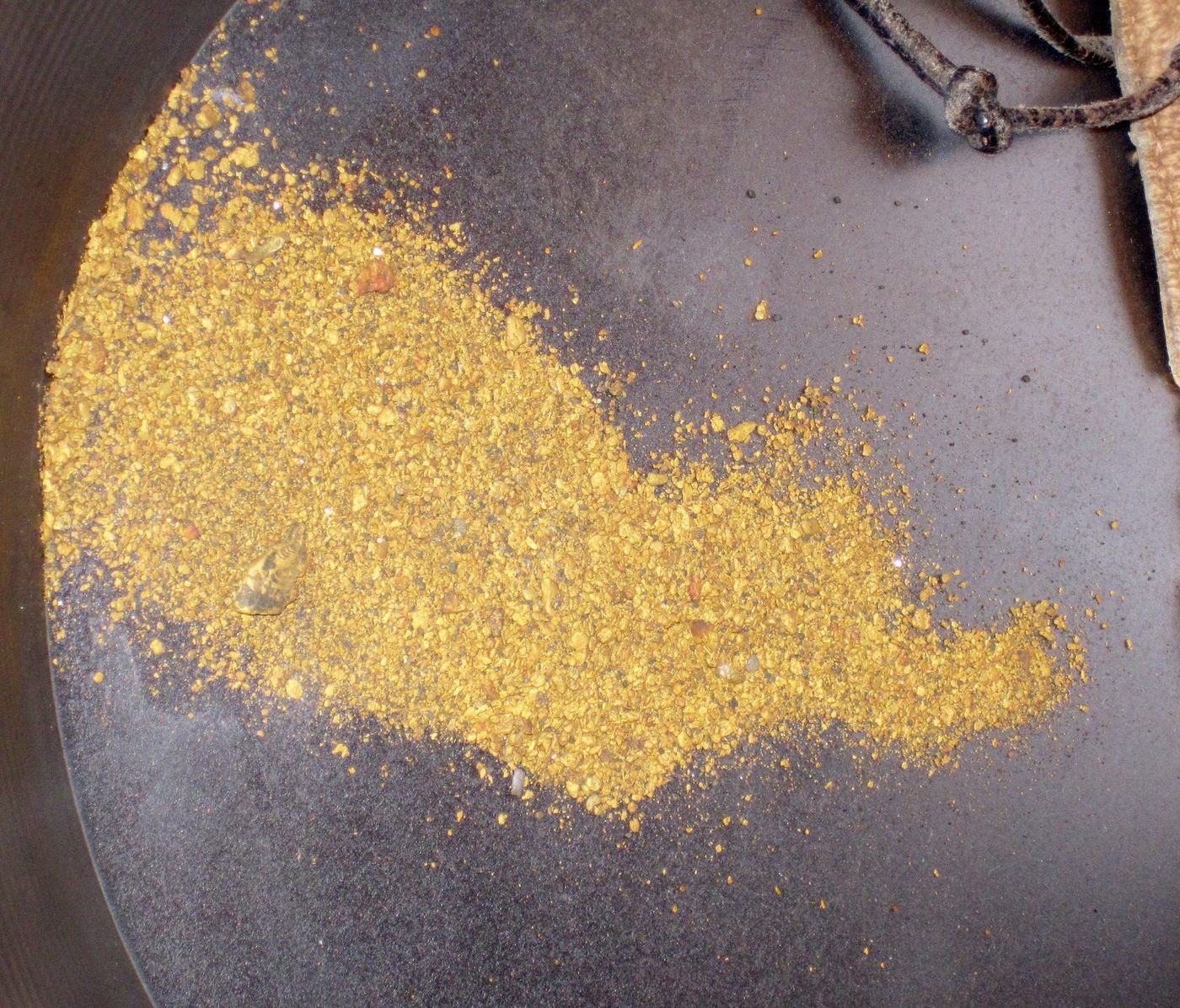
To recover fine flour gold from a bucket of heavy black-sand concentrate, reduce the volume in stages: classify the material down into narrow size grades, then separate it on a low-flow surface built for fine gold — fine-riffle silicone matting, a small clean-up sluice, a vortex bowl, or a Miller table — where gold's specific gravity of roughly 15 to 19.3 beats the black sand's ~5 so decisively that the iron oxides wash away and the gold stays put. The reason British prospectors lose so much gold is not bad luck: UK gold is fine flake with a huge surface-area-to-mass ratio, and standard riffles built for coarse gold simply let it ride over the top. This guide is the fix, step by step.
If you have already panned a stretch down to a jar of heavy grey-black sand with a few specks of colour trapped in it, you have done the hard part. Getting that gold out cleanly is a separate skill from finding it, and it is where beginners lose the most — but it is methodical. Understand the black sand and the physics of your own gold, classify, separate at low flow, and finish clean. (Learning to find that concentrate in the first place is covered in how to read a river for gold and where to pan for gold in the UK.)
Why is UK gold so hard to recover?
Because it is flour gold and fine flake, not nuggets. British placer gold has spent a very long time being ground and rolled by rivers, and the great majority of it is finer than about 100 mesh — smaller than 0.15 mm across, often much finer. That has one decisive consequence: surface area.
A nugget is compact, so its mass dominates and it drops like a stone. A flake of the same mass is spread thin and wide, giving it a high surface-area-to-mass ratio. In moving water, drag acts on surface area while gravity acts on mass — so a thin flake feels far more push from the current per unit of weight than a chunky grain does. That is why fine gold behaves as if it were much lighter than it is, rides up and over the riffles of a standard sluice, and washes straight out the bottom. The gold has not stopped being dense; the water is simply winning the tug-of-war on a thin, draggy shape.
The good news hides in those numbers. Gold is still roughly four times denser than black sand and around seven times denser than ordinary quartz sand. That density gap is enormous and it never goes away. The whole craft of fine-gold recovery is designing conditions — slow water, thin films, tiny traps, matched grain sizes — where that density gap, not the water, decides where each grain ends up.
What exactly is black sand?
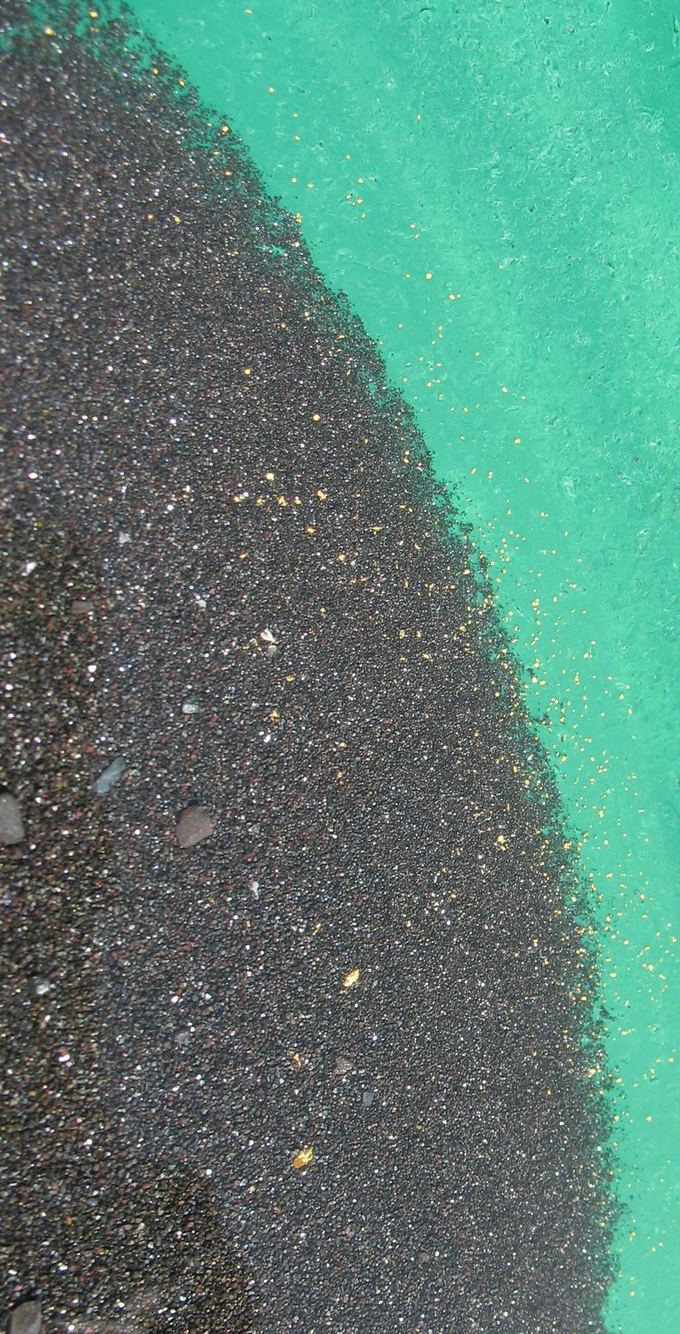
Black sand is not one mineral; it is the heavy fraction that survives once the lighter material has washed off. In UK rivers it is dominated by three iron-bearing oxides:
- Magnetite (Fe₃O₄), specific gravity ~5.2 — strongly magnetic, and usually the bulk of the black.
- Hematite (Fe₂O₃), specific gravity ~5.0–5.3 — only weakly magnetic.
- Ilmenite (FeTiO₃), specific gravity ~4.7 — an iron-titanium oxide, weakly to non-magnetic.
You may also see garnet, and occasionally cassiterite (tin oxide) in the old tin country of the South West. The practical points are twofold. First, black sand is heavy — that is why it collects in the same natural traps and pan corners as gold, and why it is a reliable sign you are on the right ground. Second, only the magnetite fraction is magnetic, so a magnet alone will never clean your gold completely. Gold outweighs every one of these minerals, which is the lever you pull to separate them.
The recovery workflow, in order
Work from bulk to finish. Rushing a cupful of raw concentrate straight onto a finishing table just clogs it. The reliable sequence is:
- Classify down — screen the concentrate to narrow size grades so every grain is roughly gold-sized.
- Run it over fine matting or a clean-up sluice — low, slow water traps the flour gold.
- Reduce the bulk with a vortex bowl — turns a jar of black sand into a gold-rich spoonful.
- Finish clean on a Miller table — the thin-film finisher for the very finest gold.
- Magnet off the black sand — lift the magnetite from the dried concentrate as a final tidy-up.
- Collect — snuffer the clean gold into a labelled vial.
You will not need every tool in that chain — which finisher you buy depends on how fine your gold is and how much concentrate you process, which is exactly what the rest of this guide sorts out.
No cons of your own to practise on?
Our UK paydirt is real gold-bearing concentrate you can run at home — the perfect way to rehearse this whole workflow on the kitchen table before you are stood in a cold river.
Step 1 — Classify down before you separate anything
This is the step beginners skip and experts never do. Before any fine separation, screen your concentrate into narrow size grades — a stacking set of classifiers at, say, 30, 50 and 100 mesh is a sensible progression — then process each grade on its own. Within a single grade, gold is dependably the heaviest particle present, so it drops out first and cleanly; mix the grades and a large light grain behaves like a small heavy one, and your flour gold escapes with the light stuff. Classifying also lets you tune the water to each grade — a brisk rinse for the coarse, a gentle trickle for the flour. Skipping it is the number-one reason a prospector watches visible colour disappear off the end of an otherwise good sluice.
Step 2 — Run it over fine matting or a clean-up sluice
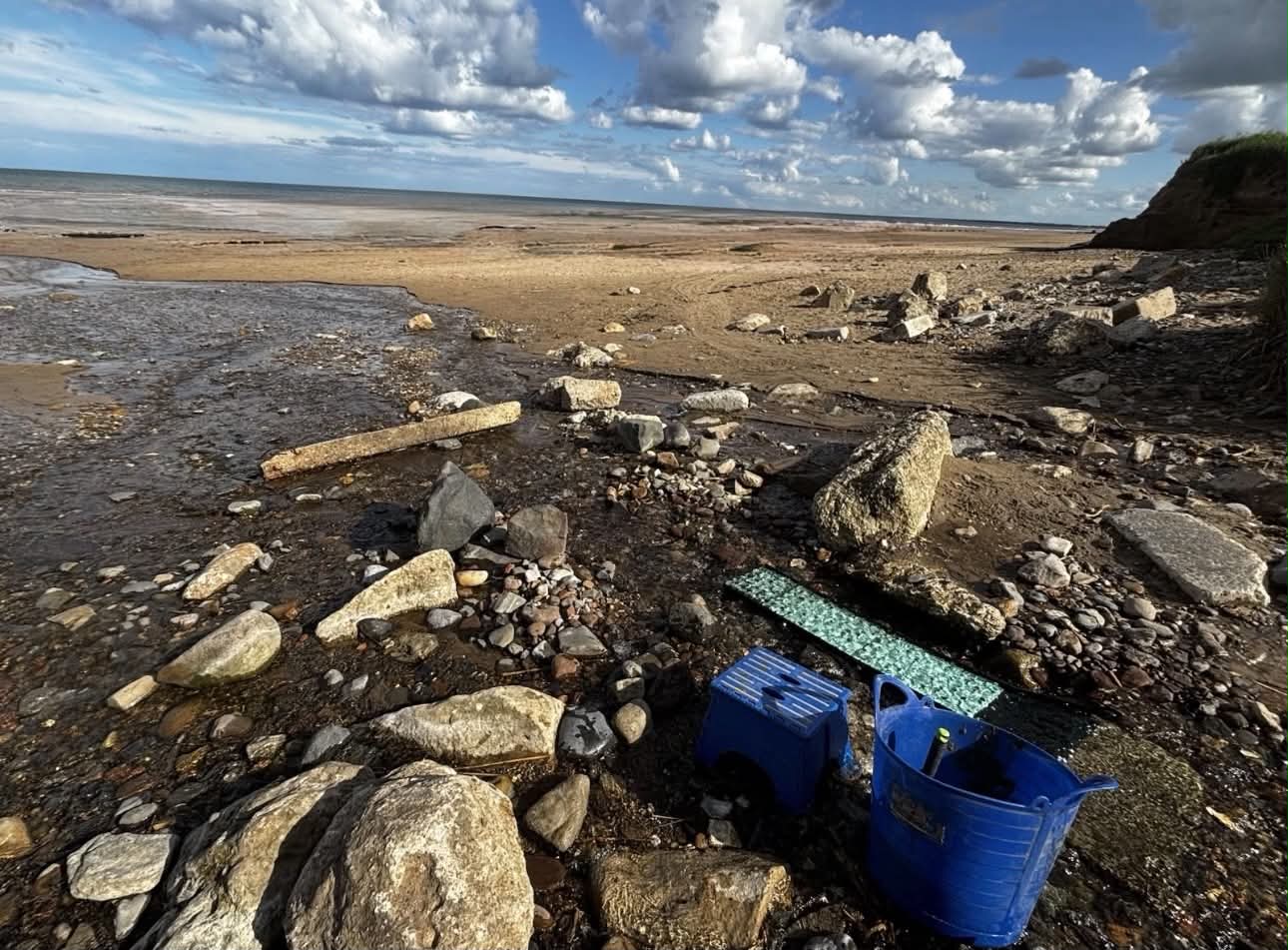
With classified concentrate in hand, the workhorse tool is fine-gold silicone matting — Vortex or Dream Riffle style — either loose in a tray or fitted into a short clean-up sluice. Standard sluice riffles create large, powerful eddies sized to trap coarse gold; fine flakes never settle in them. Fine matting instead uses a dense field of tiny moulded cells that shed small, slow eddies — just enough turbulence to let a fine flake drop into a dead spot and stay there. Feed a small pinch at a time, keep the water low and even, and let the mat work. The trade-off is you must run far less water, or the fine gold blows straight through.
Ad · British-made kit · built for UK flour gold
Gold Magnet UK pays UK Gold Prospector commission on sales from the links below and has gifted us equipment.
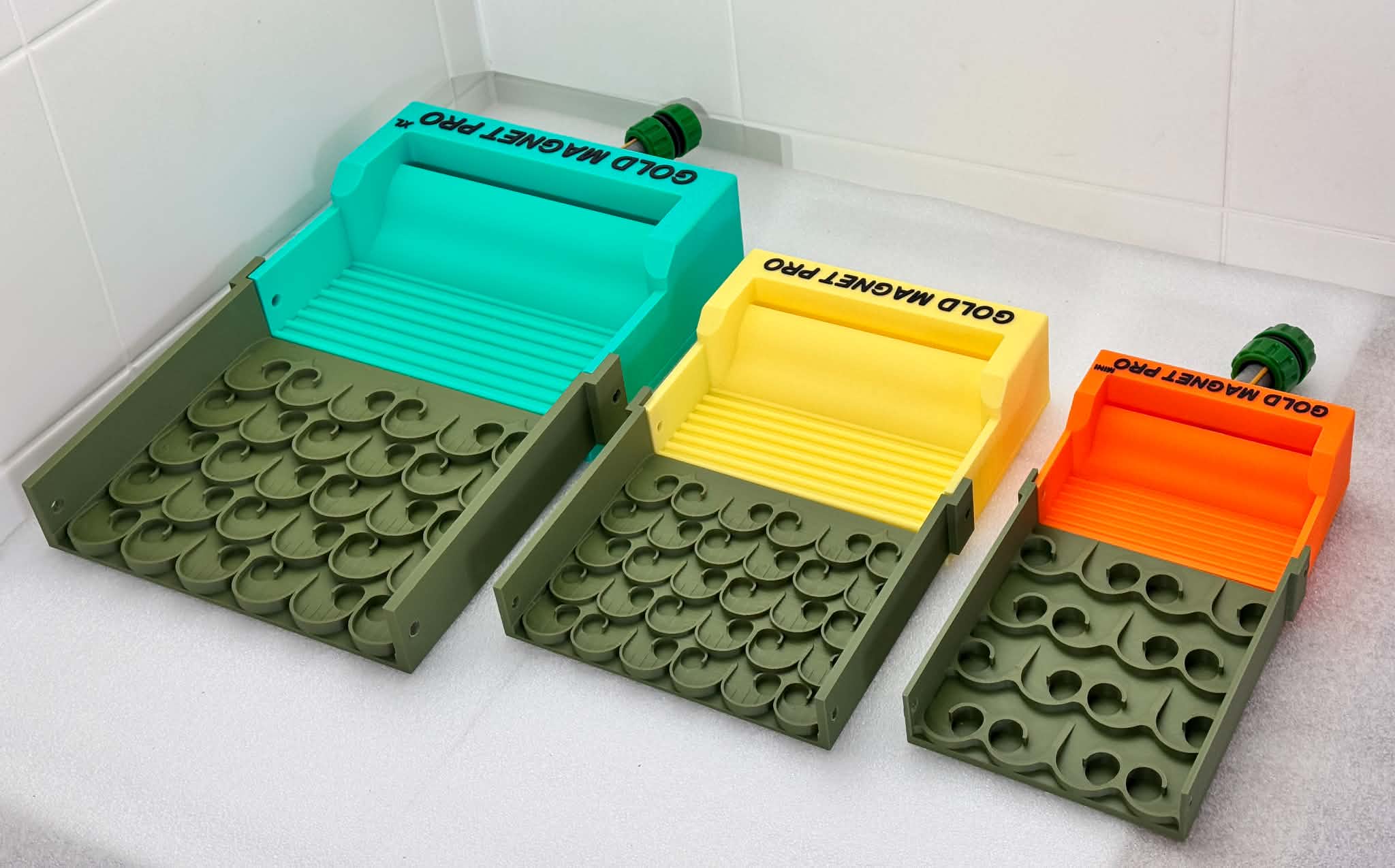
Gold Magnet UK, run by Lee Hopkins, makes clean-up gear designed specifically for the fine flake we get in British rivers — all built around fine Vortex / Dream Riffle silicone matting, the exact low-flow surface flour gold needs. It is a genuine UK maker with a 100% positive eBay record over roughly 1,900 sales.
UK Gold Prospector readers get 10% off any item with code GOLD10 — quote it in an eBay message and Lee applies a partial refund after purchase (not combinable with an existing eBay offer on the same item). Prices below are approximate — check the live listing.
The smart cheap start
A dense field of tiny moulded cells that shed slow eddies — just enough to let a fine flake drop into a dead spot and stay. The single best-value fine-gold upgrade there is.
GOLD10 = 10% off
Shop on eBay →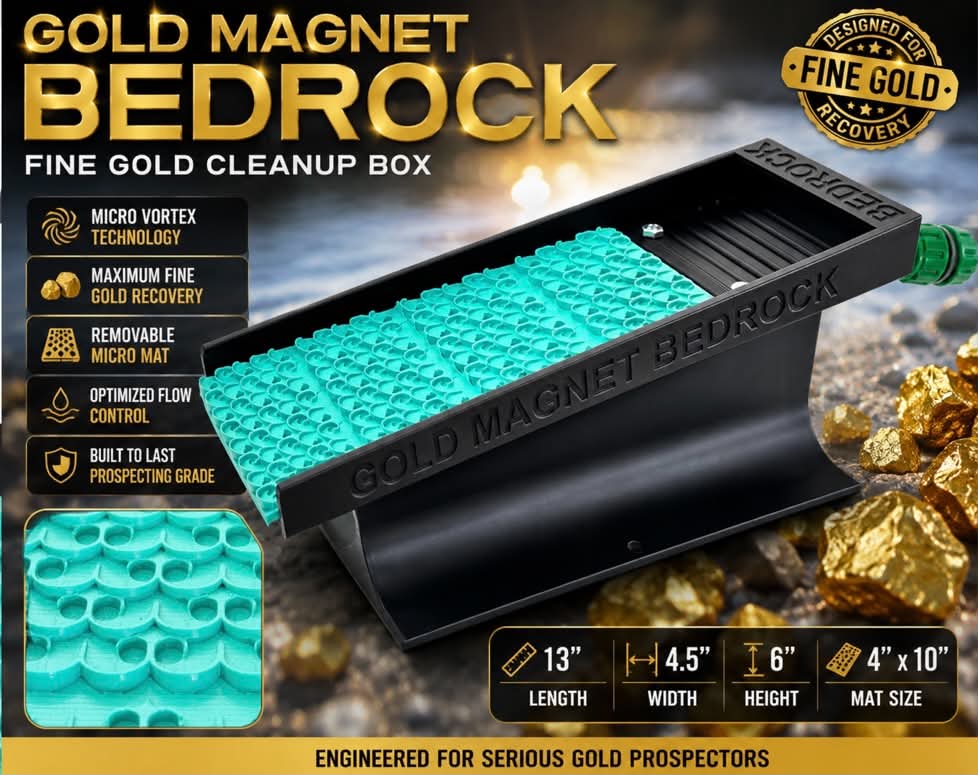
Compact clean-up box
A compact, low-water clean-up box that runs your classified concentrate over the fine matting for faster, repeatable batches than a loose tray.
GOLD10 = 10% off
Shop on eBay →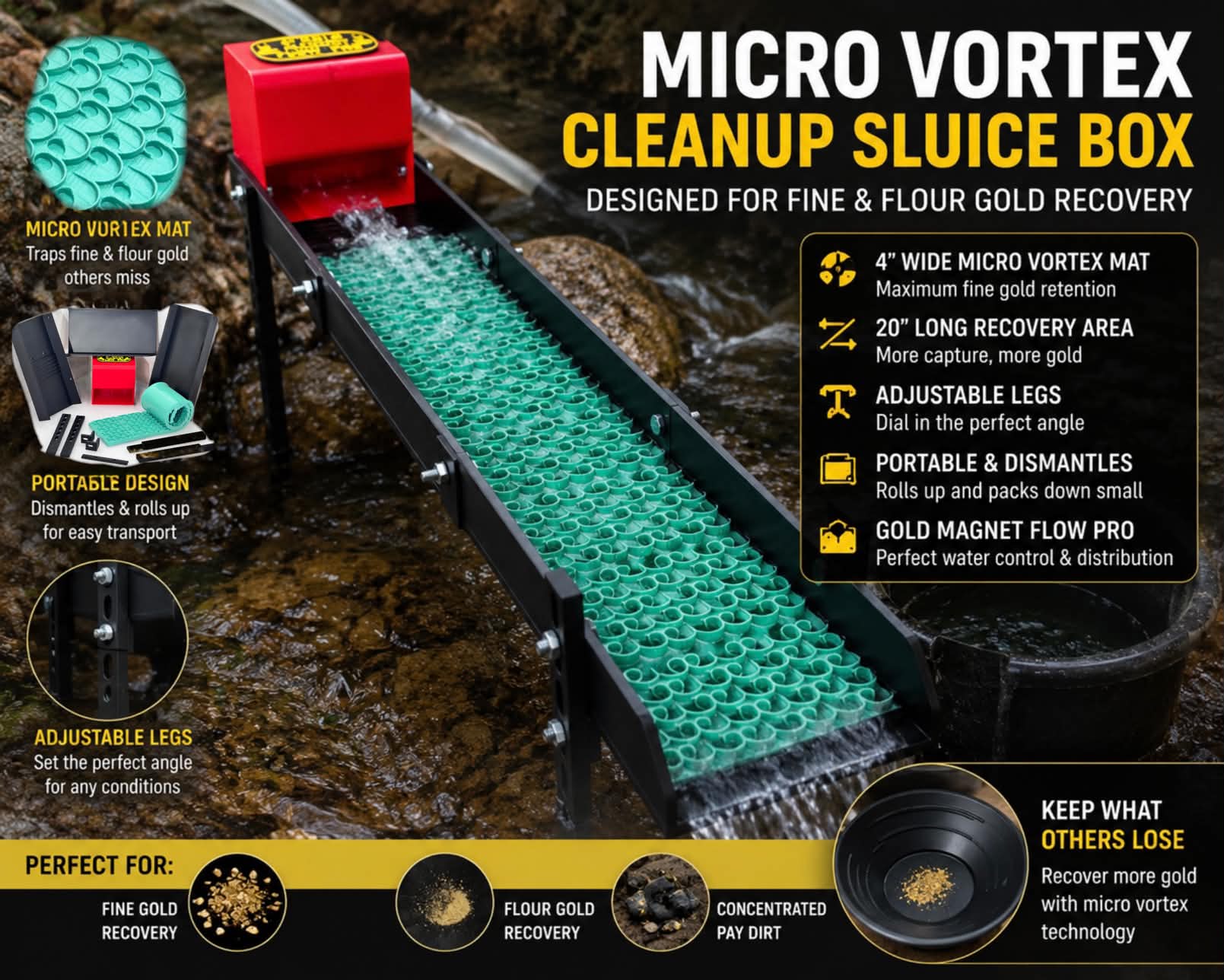
The workhorse
A wider clean-up sluice for more concentrate per pass — dial in the angle, keep the flow low and let the micro-vortex mat hold the flour gold others lose.
GOLD10 = 10% off
Shop on eBay →Step 3 — Reduce the bulk with a vortex bowl
If you have a lot of black sand, a concentrate separator such as the Vortex Bowl (around £79.99) sits neatly between matting and the final finish. Water circulates the concentrate so the heavy gold migrates and settles while the lighter black sand climbs out and spills over — doing gently and repeatably what a skilled panner does by hand, which makes it forgiving for beginners. It turns a jar of concentrate into a gold-rich spoonful in minutes, saving your Miller table for what it does best: the very last clean-up. That is exactly the tool running in the video above.
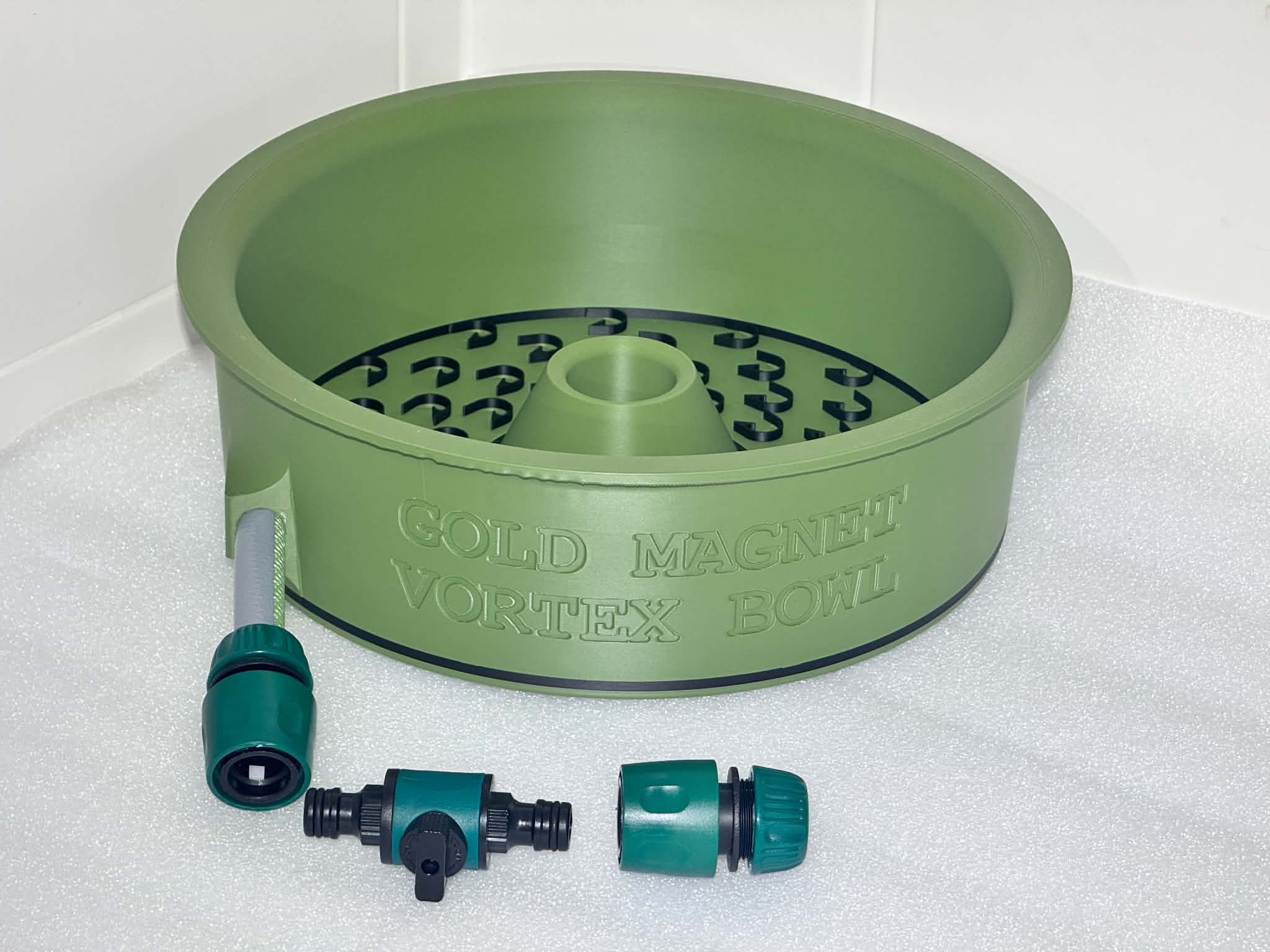
Reduce the bulk
A spinning concentrate separator that turns a jar of black sand into a gold-rich spoonful in minutes — forgiving for beginners and hands-off once the flow is set.
GOLD10 = 10% off
Shop on eBay →Step 4 — Finish clean on a Miller table
The Miller table (also sold as a ProTable, around £94.99) is the finishing tool the whole workflow builds towards. It is a low-angle table with a smooth mat down which a thin, even sheet of water flows. You trickle a small amount of concentrate onto the top; the film of water carries the lighter black sand down and off the bottom while the gold — the densest thing on the table — barely moves and collects near the top, often as a bright trail you can watch form. There is no deep water and no turbulence to fling flour gold around, which is precisely why it recovers the finest gold cleaner than anything else.
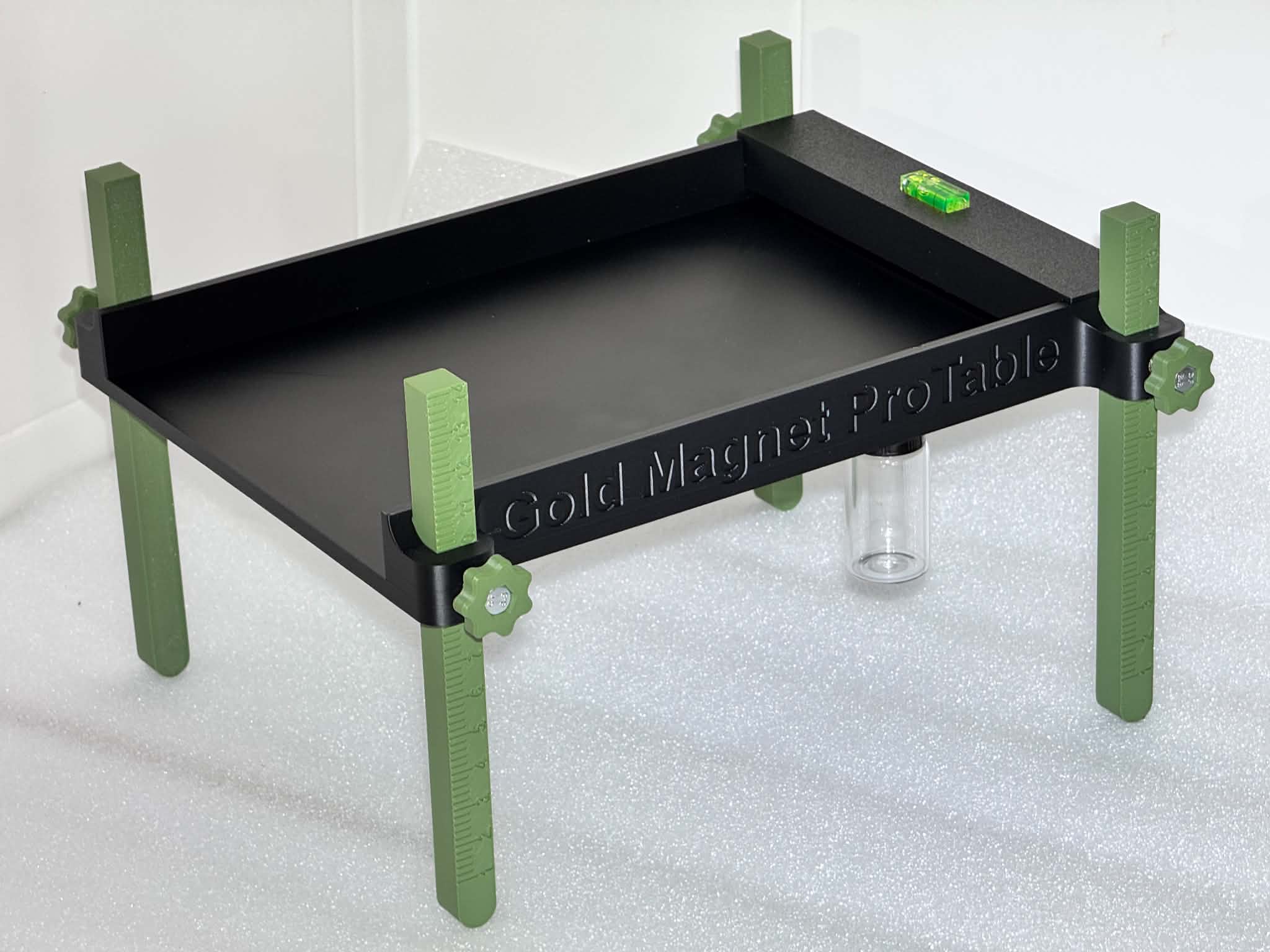
The finisher
A thin-film finishing table for the very last clean-up — the densest grains barely move while the black sand washes off, so your gold collects as a bright trail near the top.
GOLD10 = 10% off
Shop on eBay →Not ready to invest in a table yet? You can still finish beautifully by hand: dry your final concentrate on a sheet of paper, then use the "shake and blow" method — gently tap so the heavier gold trails behind, and softly puff the light sand away a little at a time, working over a tray so nothing is lost. Slow, but free, and it works.
Step 5 — Should you use a magnet on the black sand?
Yes — it is one of the quickest wins in the whole process, but as a final tidy-up, not a separation method, and knowing its limit. Most black sand is magnetite, which is strongly magnetic, so a strong magnet lifts a large part of it straight out. The trick every prospector uses: put the magnet inside a plastic bag (or wrap it in cling film) and pass it just over your dried concentrate — the magnetite jumps up and clings to the outside of the bag, and when you pull the magnet away it drops cleanly into a waste tub. No fiddly scraping.
The honest caveat: hematite and ilmenite are only weakly magnetic or non-magnetic, so the magnet will not take everything — you will still have a little dense grey sand with your gold, which is normal and exactly what the density steps above are for. Work slowly and low over dry material, or you can flick tiny flakes away with the magnetite. (One more reason the maker above is called "Gold Magnet" — the magnet is a staple of fine-gold clean-up.)
What about flood gold that floats away?
Sometimes the finest flakes sit on the water rather than in it, held up by surface tension, and no amount of density separation catches them — prospectors call it flood gold or floating gold. The established fix is chemical: add a single drop of ordinary washing-up liquid (a surfactant) to your pan or table water. It breaks the surface film so the flakes wet through and sink to where the mat or table can grip them. A small trick that noticeably lifts recovery on the very finest UK gold.
⛏ Upstream · making the concentrate in the first place
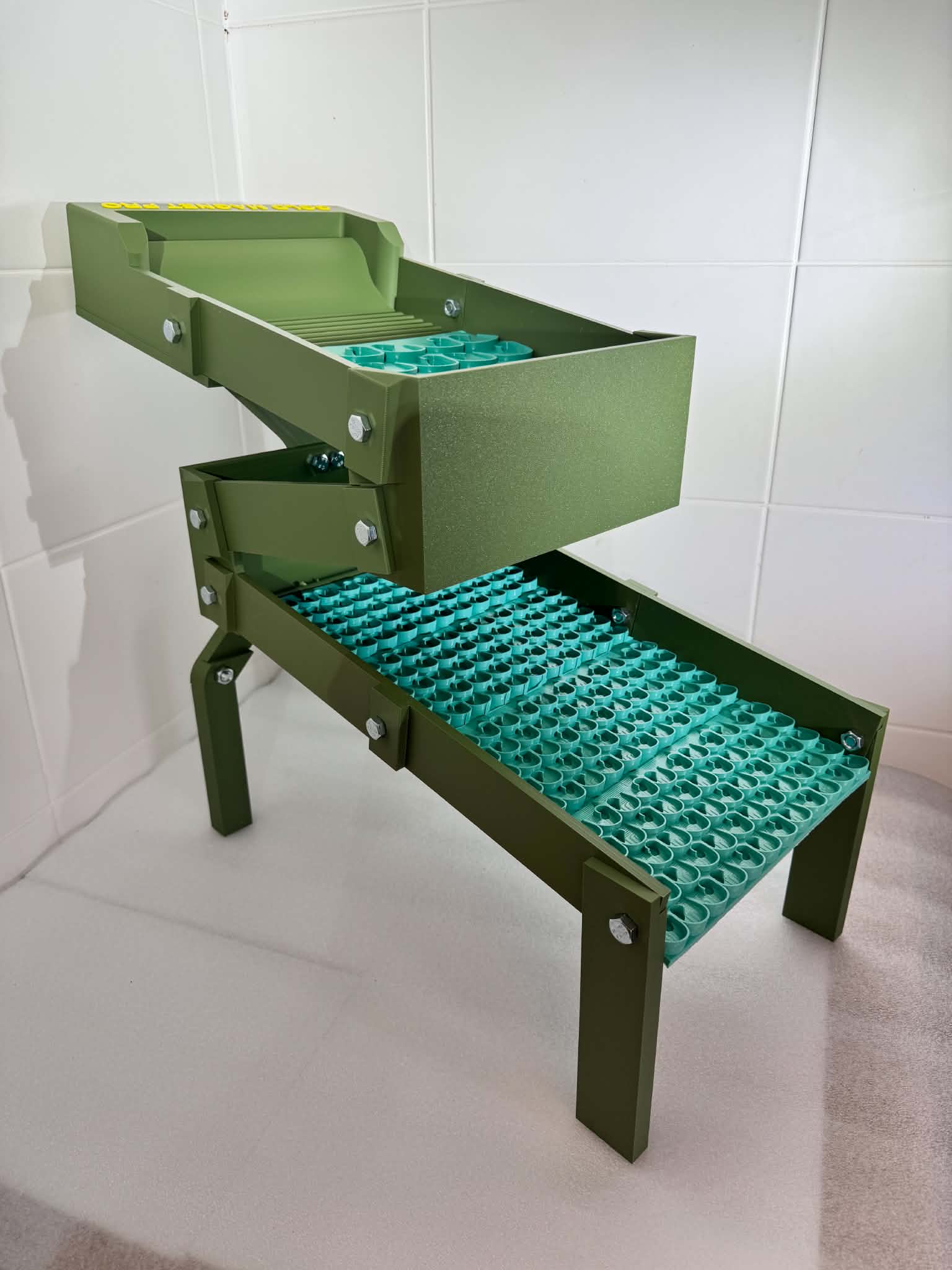
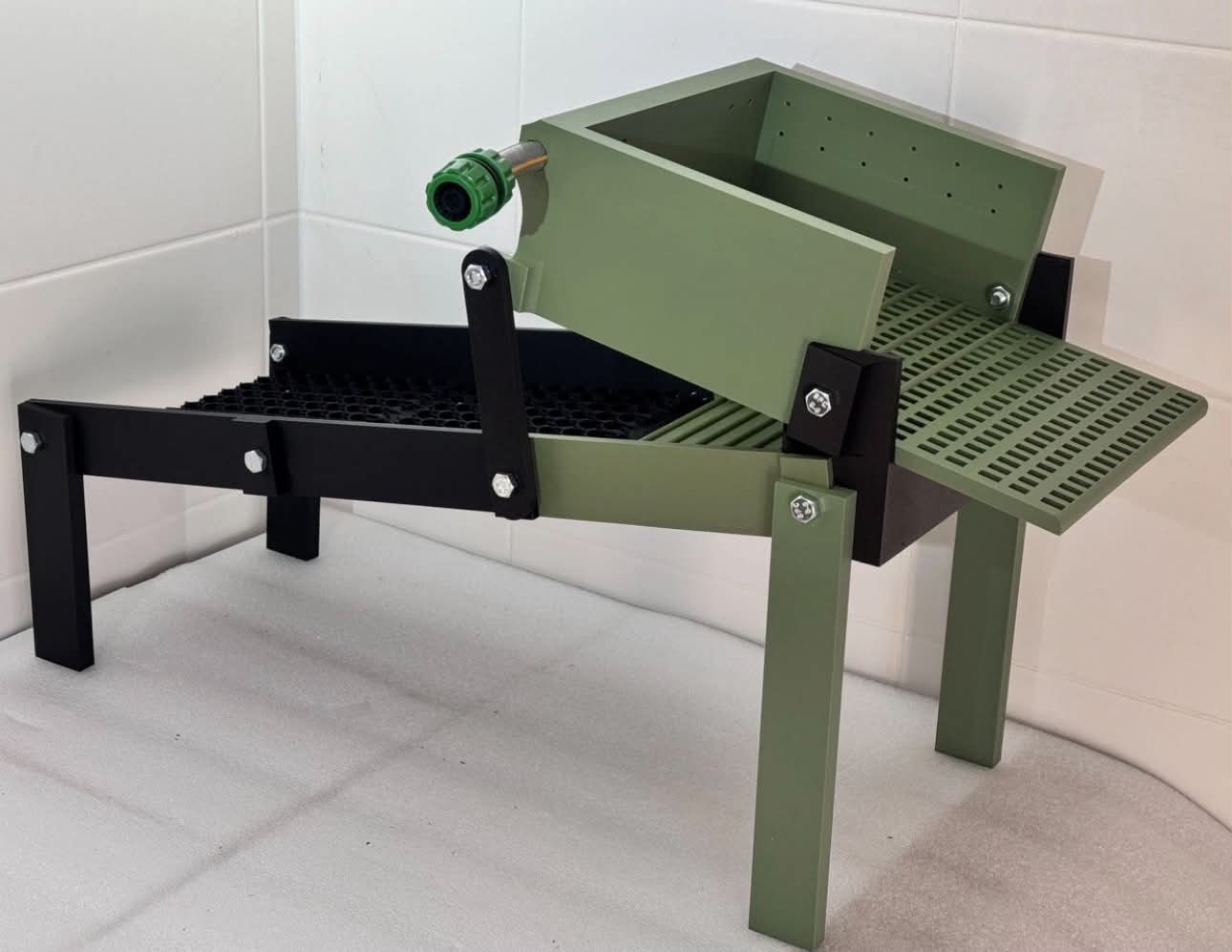
Everything above assumes you already have a jar of black sand. If you are still processing raw river gravel into concentrate, that is a job for a full-size sluice — same fine Vortex matting, just far more volume. Gold Magnet UK builds these too, so your coarse capture and your fine clean-up share one matting system.
Make concentrate
The upstream workhorse — run gravel through it in the river to build the heavy concentrate you then clean up on the matting, bowl and table above.
GOLD10 = 10% off
Shop on eBay →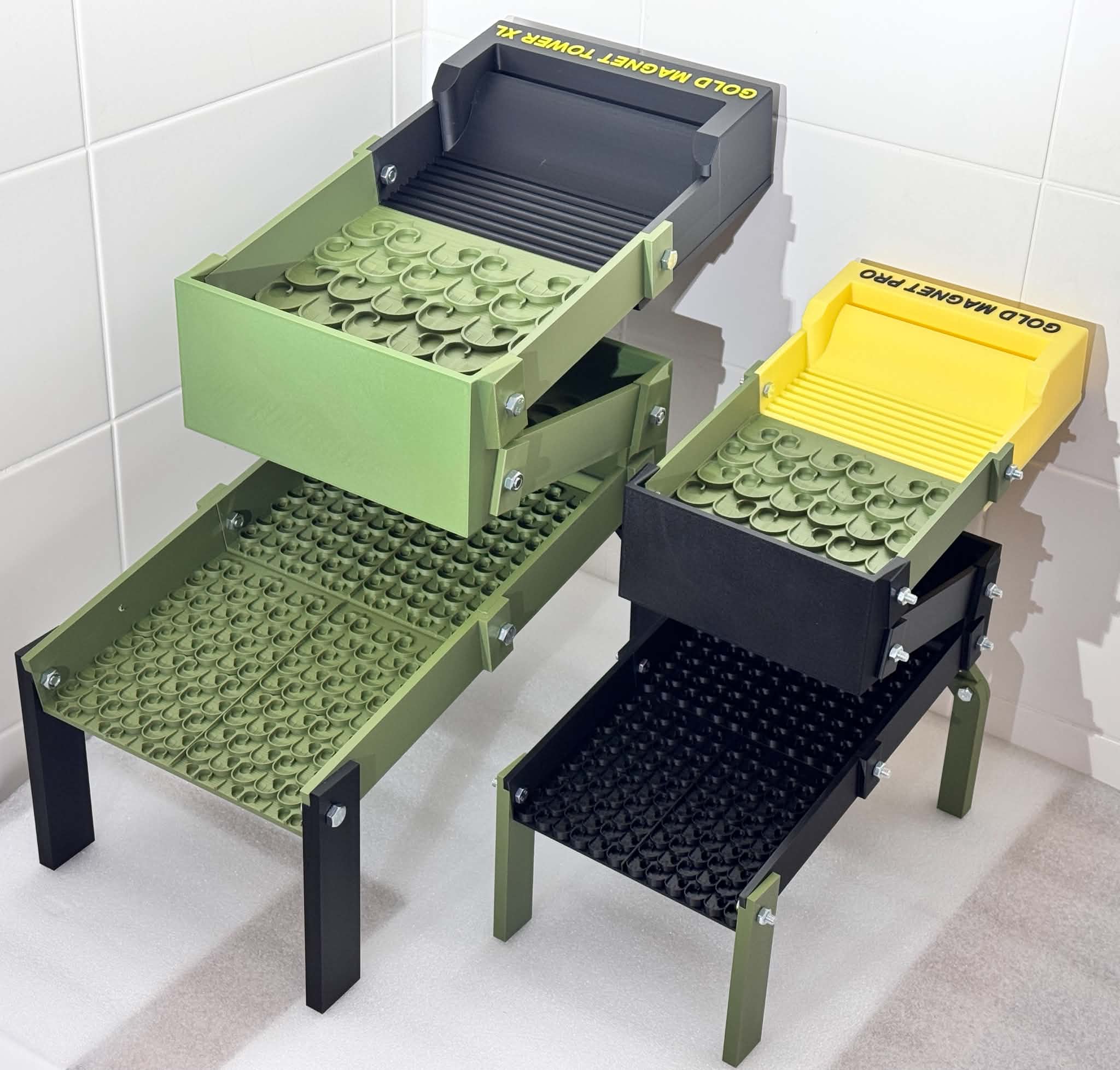
Serious volume
Stacked multi-deck sluices for high-volume work where water and landowner permission allow — later in your journey, not day one.
GOLD10 = 10% off
Shop on eBay →Which recovery tool should I buy first?
Buy for your gold, not for the most impressive gadget. The honest hierarchy:
- On any budget, start with a magnet and a fine-gold mat. Together they cost little, weigh nothing, and solve most of the fine-gold problem — the magnet removes the bulk black sand, the mat catches what the pan misses.
- Add a clean-up sluice or vortex bowl only once volume is the issue — when you are hand-panning the same concentrate for an hour and want it done in ten minutes.
- Add a Miller table last, when your gold is genuinely flour-fine or you want showcase-clean finished gold. It is the best finisher, but it is a refinement, not a starting point.
Spending £12.99 well beats spending £94.99 too early. If in doubt, get the mat and the magnet, work your concentrate, and let your own gold tell you whether you need more.
Sponsored: UK Gold Prospector partners with Gold Magnet UK. Prices are approximate at the time of writing — check the live listing. Use code GOLD10 for 10% off any item.
| Tool | What it's for | ~Price | When to buy |
|---|---|---|---|
| Vortex / Dream Riffle matting | Fine silicone mat that traps flour gold at low flow — line a tray or sluice. | £12.99+ | First upgrade — the smart cheap start for everyone |
| Bedrock Cleanup sluice | Compact, low-water clean-up of concentrate over fine matting. | £54.99 | When you want faster, repeatable runs |
| 4″ Cleanup Sluice | Wider workhorse clean-up sluice — more concentrate per pass. | £79.99 | When processing larger volumes |
| Vortex Bowl | Concentrate separator — reduces a jar of black sand to a spoonful. | £79.99 | When pan-finishing every batch is a chore |
| Miller table / ProTable | Thin-film finishing table — recovers the very finest flour gold. | £94.99 | Last — ultra-fine gold or showcase-clean finishing |
| Full-size matted sluice (30″) | Processes river gravel into black-sand concentrate. | £64.99 | Upstream — if you still need to make concentrate |
| Tower & Mega sluices | High-volume river sluicing where water and permission allow. | up to £169.99 | Serious volume, later in your journey |
Claim your 10% off. Browse the Gold Magnet UK eBay store, then send Lee an eBay message quoting GOLD10 — he refunds 10% manually after purchase. Not stackable with an existing eBay offer on the same item.
Know where the gold is before you carry a bucket home
The live map has hundreds of verified UK gold sites with access notes and likely gold type — so the cons you are cleaning up came from ground worth working.
A quick word on the law
Recovering the gold does not make it legally yours. Under the Crown's ancient Mines Royal rights, gold and silver in the UK are Crown property, and you must have the landowner's permission to prospect and pan in the first place. Panned gold is not "treasure" under the Treasure Act, but neither is it simply finders-keepers — treat what you recover as something you hold with permission, not outright. Sort access before you fill a single pan.
Frequently asked questions
How do you get fine gold out of black sand?
Exploit density. Native gold's specific gravity (~15–19.3) is roughly four times that of black sand (~5), so classify your concentrate into narrow size grades, then run each grade slowly over a fine-gold surface — silicone matting, a clean-up sluice, or a Miller table — at the lowest flow that still moves the black sand. The gold stays; the iron oxides wash off. Dry the last concentrate, lift the magnetite with a magnet, and snuffer up the gold.
Why is UK flour gold so hard to recover?
UK gold is fine flake with a high surface-area-to-mass ratio. Water drag acts on surface area while gravity acts on mass, so a thin flake feels far more push from the current than a chunky grain — it rides over standard riffles built for coarse gold and washes out. Slowing the water right down and using fine matting or a Miller table lets density win instead of the current.
What is black sand made of?
Mostly magnetite (SG ~5.2), with hematite (~5.0–5.3) and ilmenite (~4.7) — all iron or iron-titanium oxides. It collects in the same traps as gold because it is heavy, which makes it a good sign you are on productive ground. Only magnetite is strongly magnetic, so a magnet removes some but never all of it.
Do you have to classify concentrate before separating fine gold?
Yes — it is the most important step. Density separation only works cleanly when grains are a similar size, because a large light grain can behave like a small heavy one in moving water. Screening your concentrate to grades such as 30, 50 and 100 mesh and processing each separately makes gold reliably the heaviest particle in the batch, so it drops out first.
What is the cheapest way to improve fine-gold recovery?
A length of fine-gold silicone matting, from around £12.99, paired with a magnet. The mat's micro-riffle surface catches flour gold that a coarse sluice or a hurried pan would flush away, and the magnet strips out the bulk of the black sand in seconds. Together they cost little and solve most of the fine-gold problem — far better value as a first purchase than a full finishing table.
Does a magnet remove all the black sand from gold?
No. A magnet only lifts the magnetic fraction — chiefly magnetite. Hematite and ilmenite are weakly or non-magnetic and stay behind, so a magnet alone never fully cleans your gold. Use it on dried concentrate as a final tidy-up, sheathed in a bag, passing slowly so you do not fling fine flakes away with the magnetite.