Short answer
The largest gold nugget ever recovered in Britain is the Reunion Nugget at 121.3 g, found in a Scottish river in 2019. Before it, the record was the Douglas Nugget at 85.7 g (2016), now on display at the Hunterian Museum in Glasgow. Those two finds are famous precisely because they are exceptional: genuine gold nuggets are vanishingly rare in the UK. British natural gold is overwhelmingly fine flake and flour gold, recovered by panning rivers - not by lifting nuggets out of the ground. A handful of real British nuggets exist, but no one can promise you one.
Every new prospector pictures the same thing: a heavy, knuckle-sized lump of gold glinting in the bottom of the pan. It is the image that sells the hobby - and it is the single biggest source of disappointment in it. Britain does produce real gold nuggets. It just produces them so rarely that the few that exist have names, weights and museum cases. This is the honest story of Britain's biggest nuggets, why the country so seldom makes them, and what your realistic chances actually are.
We will keep every figure grounded, because false promises in this corner of the hobby cost people money and morale. By the end you will know the real British record-holders, how they compare with the giants found overseas, why UK geology favours flake over nuggets, where the law stands, and how to give yourself the slimmest-but-genuine chance of an exceptional find. Every gold-bearing river we mention is plotted on the UK Gold Prospector interactive map with access notes attached.
In this guide
See where Britain's gold actually is on the live map
200 BGS-verified gold-bearing rivers and streams with GPS coordinates, geology and access notes - including the Highland and Lowland country that has produced Britain's rare nuggets.
What Counts as a Gold Nugget?
It helps to be precise about the word, because "nugget" gets used loosely and that is where the false hope creeps in. In prospecting terms, the gold you recover comes in a rough size hierarchy. The finest is flour gold - sub-millimetre specks you only see when you tilt the pan to the light. Above that sit flakes, flat pieces typically a millimetre or two across, which make up most of the recoverable mass on a good UK day. Bigger again are pickers - pieces large enough to lift between finger and thumb, the size of a rice grain or larger, the mark of a productive day for a regular. A true nugget is a substantial, free-standing lump of gold, and in a British context that means something exceptional rather than something you can plan around.
The reason this matters is that the overwhelming majority of British natural gold is flake and flour. It is fine, it is dispersed through river gravel, and it is recovered by panning and sluicing rather than by spotting a lump. Anyone describing the UK as nugget country has the geology wrong. Our companion guide on whether you can metal detect for gold in the UK makes the same point from the kit angle: British gold is too fine and too scattered for a detector to sense, which is exactly why nuggets here are headline events.
Britain's Biggest Gold Nuggets
Here is the honest league table. It is short, and that brevity is the whole story.
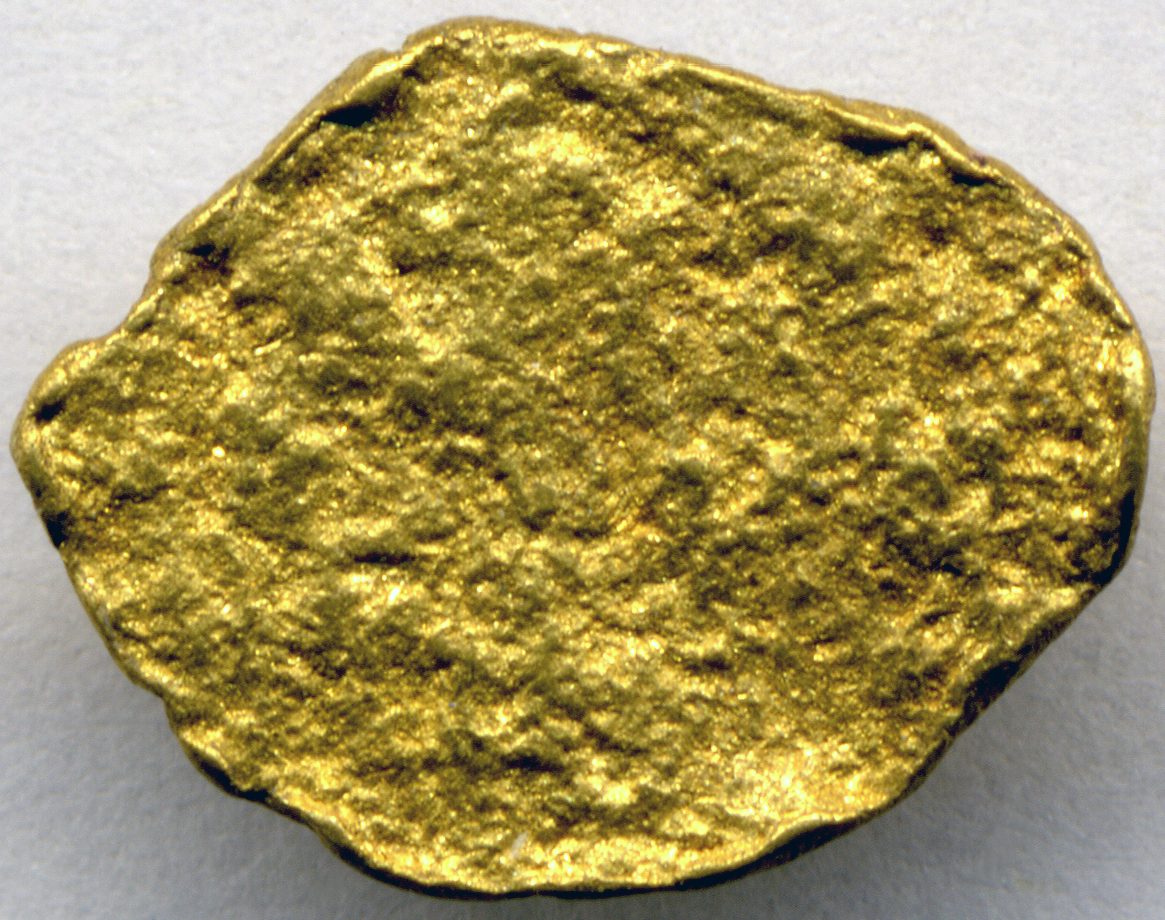
The Reunion Nugget - 121.3 g (2019)
The largest gold nugget ever recovered in Britain is the Reunion Nugget, weighing 121.3 grams, found in a Scottish river in 2019 by an anonymous prospector. It was recovered by sniping - snorkelling with hand tools to inspect bedrock pockets directly underwater - rather than by conventional panning, and the exact location was deliberately withheld at the time of recovery. It is widely attributed to a Highland river system. The Reunion Nugget made national news for a reason: nothing larger has been documented in Britain, and finds on that scale are generational rather than seasonal.
The Douglas Nugget - 85.7 g (2016)
Before the Reunion find, the British record was held by the Douglas Nugget at 85.7 grams, recovered in 2016. It is now on public display at the Hunterian Museum at the University of Glasgow, where you can see for yourself what a genuine British nugget actually looks like - which, for most prospectors, is the closest they will ever get to one. The Douglas Nugget remains the second-largest British nugget on record and the most accessible to view.

The Mennock Water nugget - around 18 g
Scotland's Lowther Hills have their own documented nugget: the Mennock Water, near Wanlockhead, has produced an 18-gram piece quoted by local sources at a value of around £10,000 in current market terms. That is small beside the two modern Scottish record-holders, but it is a real, documented nugget from one of the most accessible prospecting districts in Britain - the burns of the Lowther Hills have shed flake gold for at least 500 years, and the rare larger piece does turn up. Full detail on that district is in our Wanlockhead and Leadhills guide.
What about the historic rushes?
Britain's only true gold rush, the 1868-69 Sutherland Gold Rush at Kildonan, produced its share of larger pieces - but documentation from the rush is patchy, most finds were never systematically weighed and recorded, and the typical exceptional find was a small picker of a few grams rather than a true nugget. No single piece from the rush can be securely identified as a record-holder. The same is true of historic Welsh and Cornish gold: documented nuggets are absent from the recreational record, and the gold is recovered as flake. In short, Britain's nugget history is genuinely measured in a handful of named modern finds, not a long catalogue.
Why the UK So Rarely Makes Nuggets
This is not bad luck - it is geology. Nuggets form and survive where two things line up: a concentrated primary gold source, and a landscape that delivers the eroded gold into rivers without grinding it to dust. Britain is short on both, for understandable reasons.
First, British gold is overwhelmingly alluvial - river-borne flake liberated from the bedrock and sorted into stream gravels over the post-glacial period. The last ice age scoured the source rocks and the rivers have been re-sorting the gold ever since, but the dominant product of that process here is fine flake, not coarse lumps. The primary sources - dispersed sulphide horizons in the Southern Uplands, quartz veins in the Dalradian Highlands and the Welsh Dolgellau belt, altered granite in Sutherland - shed mostly fine gold into the drainage.
Second, the few naturally coarse pieces that do form face a long, punishing journey. UK rivers are short, steep in their upper reaches, and have spent thousands of years tumbling and battering their gravels. Soft gold pieces get hammered flat and abraded down with every spate. A nugget needs to reach a deep bedrock trap and stay there to survive - which is precisely why the Reunion Nugget came out of a bedrock pocket reached by snorkelling, not off a gravel bar. The country that produces Britain's exceptional finds is the deep, sheltered bedrock crevice, and there are very few of those holding a piece that large.
The one-line version: Britain makes flake gold by the river-mile and nuggets by the generation. The flour and flakes in the gravel are reliably there in the right rivers; a nugget is a lottery, not a plan.
How Britain Compares With the World's Giants
To put Britain's 121.3-gram record in perspective, it helps to look at where the truly enormous nuggets come from - and the answer is: not here. The world's headline nuggets are overseas, in arid, geologically young goldfields where coarse gold formed in quantity and survived close to the surface.
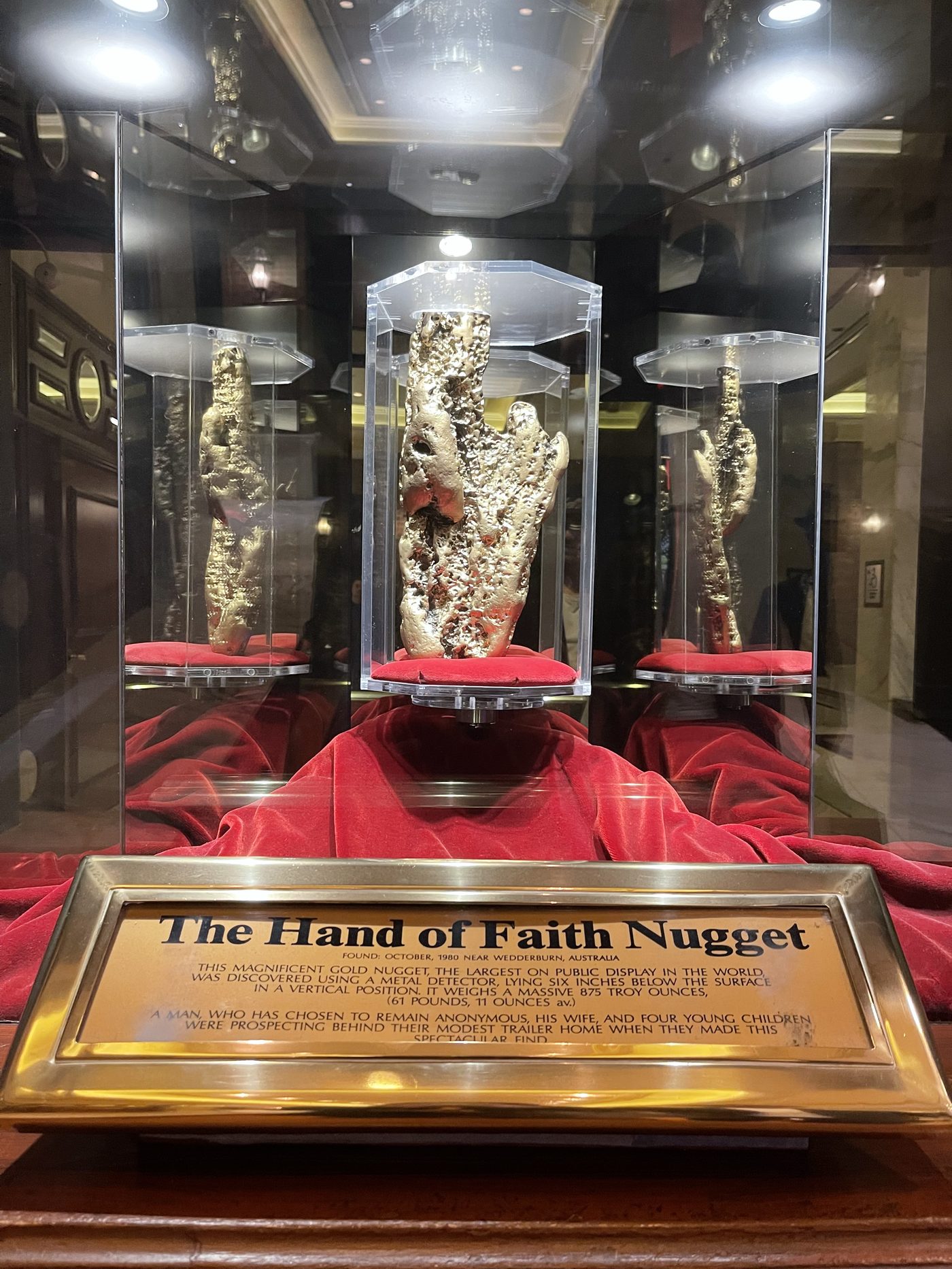
The most famous is the Welcome Stranger, unearthed in Victoria, Australia in 1869, generally regarded as the largest gold nugget ever found - a mass weighing in the order of 70 kilograms of gold. The Hand of Faith, found in Victoria in 1980 and now displayed in Las Vegas, weighs around 27 kilograms and is among the largest ever recovered with a metal detector. Set those beside Britain's 121.3-gram Reunion Nugget and the scale is stark: the biggest overseas finds are measured in tens of kilograms, Britain's in hundreds of grams - a difference of roughly five hundred-fold.
That is not a knock on British prospecting; it is a reminder to set expectations by the right yardstick. Places like Victoria, the western United States and Western Australia are detector-and-nugget country. Britain is panning-and-flake country. They are different geologies producing different gold, and the romance here is recovering real gold with your own hands from storied rivers - not matching the Welcome Stranger.
Who Owns a Nugget You Find?
Suppose you beat the odds. The first thing to understand is that the gold is not automatically yours to keep, because in Britain naturally occurring gold belongs to the Crown. Under the Royal Mines Act 1424 in Scotland and by royal prerogative (the Case of Mines, 1568) in England and Wales, unworked gold and silver are Crown property - a nugget in a riverbed is, in the strict legal sense, the Crown's regardless of who lifts it out.
In practice, recreational prospecting works within that framework rather than around it. In Scotland, the established permit schemes at Kildonan (Suisgill Estate), Wanlockhead (Buccleuch Estate via the Museum of Lead Mining) and Tyndrum (Strathfillan Community Development Trust) provide the landowner permission that lets you pan and keep your finds within the designated stretches, while access to the land itself is covered by the Land Reform (Scotland) Act 2003. Scotland's regulator, SEPA, also imposes a good-practice closed season - broadly no panning between 1 November and 31 May where salmon and trout spawn. In England and Wales there is no equivalent recreational permit scheme: the route is direct landowner permission plus Environment Agency or Natural Resources Wales compliance, and the Crown Estate does not issue recreational gold-panning licences.
One more legal point, often confused with natural gold: if you ever found a buried gold object over 300 years old - a coin or a worked artefact rather than a natural nugget - that falls under the Treasure Act 1996 and must be reported via your local Finds Liaison Officer. A natural nugget is a different category, governed by the Crown's Mines Royal rights. Either way, the responsible approach is the same: permission first, light touch, never dig the bank. The full picture for panners is in our UK gold panning laws guide.
How to Give Yourself the Best (Slim) Chance
Let us be clear-eyed: no honest guide can promise you a nugget, and the realistic outcome of any UK trip is fine flake and a snuffer bottle of black sand. But if an exceptional find is what you dream of, the few British nuggets on record do point at how to load the dice very slightly in your favour.
- Fish the bedrock, not the bar. Britain's biggest find came from a bedrock pocket reached underwater. Coarse gold survives only in deep, sheltered traps - cracks and crevices in the bedrock, pressure shadows behind immovable boulders - so that is where the rare large piece will be, not in the loose surface gravel.
- Work the most nuggetty ground. Sutherland's altered-granite source is the most concentrated and the most "nuggetty" in Britain, and it produced both the 1869 rush and the modern record finds. The Scotland locations guide covers where that country is and how to access it.
- Go after a spate. A settled, low-water spell two to six weeks after a flood is when the river has re-sorted its gravels and exposed the deep traps - the most productive single window for any kind of recovery.
- Learn to read water properly. The difference between an empty pan and a good one is almost always technique, not luck. Our river-reading guide covers exactly where heavy gold collects.
- Pan everything, keep your concentrates. Larger pickers hide in your black sand. Take your concentrate home and process it carefully rather than chasing clean recovery on the bank.
Do all of that and you maximise a genuinely small chance while guaranteeing the real reward: flake gold you recovered yourself, in some of the most storied country in Britain. That, not a 121.3-gram lump, is what a UK prospecting trip delivers - and it is plenty. A free 16-page summary of the best beginner sites across the UK is in our Beginner's Pack.
Frequently Asked Questions
What is the biggest gold nugget ever found in the UK?
The Reunion Nugget, weighing 121.3 g, recovered from a Scottish river in 2019 by an anonymous prospector using sniping - snorkelling with hand tools to inspect bedrock pockets. The exact location was withheld and it is widely attributed to a Highland river system. The previous record-holder, the Douglas Nugget at 85.7 g (2016), is on display at the Hunterian Museum at the University of Glasgow.
Can you find gold nuggets in the UK?
Genuine nuggets exist in Britain but are vanishingly rare - the few on record have names, weights and museum cases. UK natural gold is overwhelmingly fine flake and flour gold, dispersed through river gravels and recovered by panning, not by lifting lumps. You can realistically expect flakes; a nugget is an exceptional, generational find, not something any honest guide can promise.
Why are gold nuggets so rare in Britain?
It is geology. British gold is almost entirely alluvial flake liberated from dispersed or vein sources and sorted into stream gravels. UK rivers are short and steep, and thousands of years of spates batter soft gold flat and grind it down. A nugget only survives if it reaches a deep bedrock trap and stays there - which is why Britain's biggest find came out of a bedrock pocket reached by snorkelling rather than off a gravel bar.
How does a British nugget compare with the world's biggest?
It does not, in scale. Britain's record is the 121.3 g Reunion Nugget. The world's giants come from arid overseas goldfields - the Welcome Stranger from Victoria, Australia (1869), generally regarded as the largest ever at roughly 70 kg, and the Hand of Faith (Victoria, 1980) at around 27 kg. The biggest overseas finds are measured in tens of kilograms; Britain's in hundreds of grams. They are different geologies producing different gold.
If I found a gold nugget in the UK, would I get to keep it?
Not automatically. Naturally occurring gold belongs to the Crown under the Royal Mines Act 1424 (Scotland) and by royal prerogative (England and Wales). In practice, Scotland's permit schemes at Kildonan, Wanlockhead and Tyndrum give you landowner permission to pan and keep finds within designated stretches; in England and Wales the route is direct landowner permission plus regulator compliance. Always pan with permission and a light touch.
Important: All UK gold prospecting is subject to Crown gold rights (the Royal Mines Act 1424 in Scotland, royal prerogative in England and Wales), and to country-specific access, environmental and protected-site law. Naturally occurring gold and silver are Crown property. In Scotland, follow SEPA good-practice criteria including the spawning closure; in England and Wales there is no recreational permit scheme, so obtain landowner permission and comply with the Environment Agency or Natural Resources Wales. Never dig the bank. Nugget weights and finds cited here reflect documented records; this article is general guidance, not legal advice - verify current law and access with the relevant authority. Full detail in our UK gold panning laws guide.
Pan where Britain's gold really is
200 BGS-verified gold-bearing rivers across Britain with GPS coordinates, geology and access notes - including the Highland and Lowland country behind Britain's rare nuggets.
Free Beginner's Pack — 16-page PDF: top 10 UK locations with GPS, equipment checklist, legal cheat sheet and app tutorial.
Get the Free Pack →