Every prospector has the same heart-stopping moment on their first trip: a flash of yellow in the gravel, the rush of certainty that it's gold — and then the slow realisation it's pyrite, "fool's gold", glinting back at them. The difference is real, and once you know what to look for it takes seconds to tell apart. This is a field guide to the minerals you'll actually meet in a UK pan, built around the same Associated Minerals tags shown on every location card in the UK Gold Prospector map. For each one: what it is, what it looks like, the tell against real gold, what its tag means on the map, and whether it's a good sign.
Want to see these tags in the field?
Every location on the live map lists its associated minerals, with GPS coords and access notes for 200 BGS-verified UK gold sites.
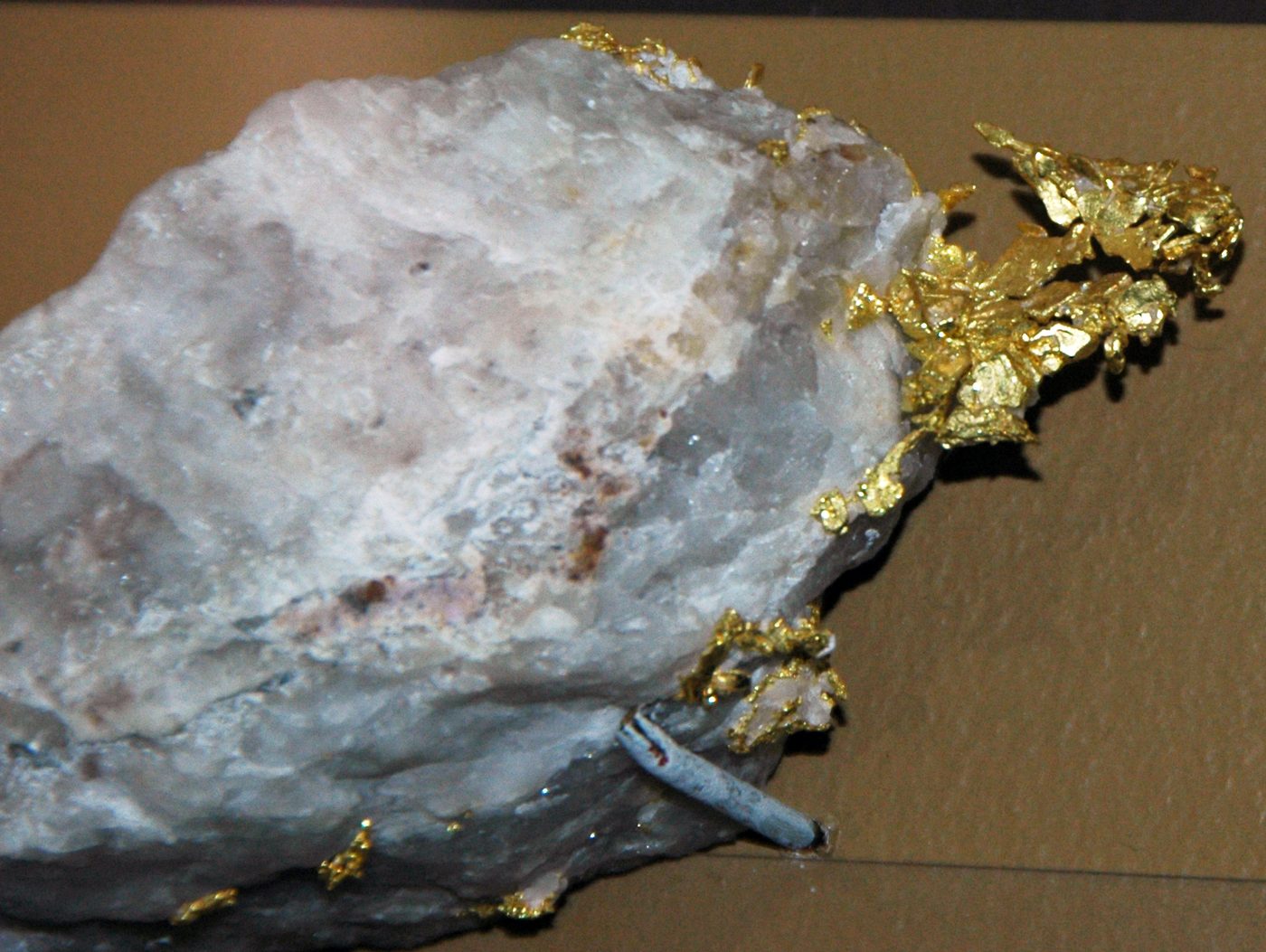
1. Gold — the real thing (the reference)

Native and placer gold is the standard every other mineral in your pan gets measured against, so learn it first. It is a rich, warm, buttery yellow — and crucially it stays exactly that colour whether it's wet or dry, in bright sun or in shadow, and even underwater. It does not sparkle or throw flashes; it has a soft, steady metallic gleam.
Gold is soft enough to bend, dent and flatten — a flake will smear rather than break — and it is extraordinarily heavy (specific gravity about 19.3). That weight is why panning works: gold sinks straight to the bottom of the pan and sits locked in the trap with the black sand while everything lighter washes away. In a UK river it shows up as smooth, rounded flakes, flour gold or, very occasionally, a small nugget — never as sharp cubes or crystals.
On the map: the gold and Native gold tags are the headline — a recorded gold occurrence at that site. This is the one you're chasing.
2. Pyrite — "fool's gold", the classic mix-up

Pyrite is the mineral that gave "fool's gold" its name, and it catches everyone once. It is a pale, brassy, slightly greenish-yellow — colder and lighter than gold's warm butter-yellow — and it loves to form sharp geometric shapes: cubes, twelve-sided crystals and angular grains. The moment you tilt it to the light it glints and flashes, because light is bouncing off flat crystal faces.
It is also brittle. Press a grain with a pin or knife point and it shatters or crumbles to a dark greenish-black powder, where gold would simply dent. And it's much lighter than gold, so it won't hold the very bottom of the pan the way gold does.
The tell: tilt it and press it. Gold keeps a steady gleam from every angle and bends; pyrite throws sparkles and shatters. If it's a perfect little cube, it's pyrite.
On the map: pyrite is common in UK gold country and is itself a pathfinder — pyrite-bearing quartz veins often carry gold. A positive sign for the ground, even though the brassy flake in your pan is not the prize.
3. Mica — not a tag, but the #1 beginner mistake

Mica isn't a map tag because it has no value — but it fools more beginners than pyrite ever does, so it earns its place here. Muscovite and biotite mica occur as thin, papery flakes that, in direct sunlight, flash a brilliant gold or bronze and lie flat and shiny against the gravel. For half a second it looks exactly like a field of fine gold.
Three things give it away instantly. It is essentially weightless, so it rides high in the pan and floats off the top with the light sand — gold sinks and stays. It changes colour with angle: tip a flake edge-on and the gold flash vanishes to silver, grey or clear, where gold stays gold. And it crushes to powder under a fingernail, while gold just flattens.
The tell: weight and the angle-flash. If it's light enough to swirl off the top of the pan and it stops looking gold the moment you tilt it, it's mica.
4. Chalcopyrite — the "copper" tag

Chalcopyrite is the third member of the gold-mimic family and the main copper ore in Britain. It's a brassy gold-yellow, often a touch deeper and more golden than pyrite, and it frequently carries a striking iridescent blue-purple-green "peacock" tarnish across its surface — a film of colour that no real gold ever shows. It is softer than pyrite but still brittle, and like pyrite it is lighter than gold.
If you see that oily rainbow sheen on a brassy grain, you're almost certainly looking at chalcopyrite (or its close cousin bornite) rather than gold.
On the map: the copper tag flags copper mineralisation, of which chalcopyrite is the principal ore. A mixed signal — some copper-sulphide systems carry gold, but the brassy grains themselves are not it.
5. Quartz — the "quartz" and "quartz veins" tags

Quartz isn't a metal and won't be mistaken for gold, but it's one of the most important things on this list. It's white, milky or glassy and colourless, with a greasy-to-glassy lustre, and it forms the pale veins that cut through darker bedrock. Those quartz veins (or "reefs") are the classic host for lode gold — gold that crystallised in the vein itself.
When a river is full of white quartz pebbles and quartz sand, it's telling you that quartz reefs are eroding somewhere upstream — and any gold those reefs contained is being washed down with them. Spotting quartz float and tracing it back uphill is one of the oldest gold-hunting techniques there is.
On the map: quartz and quartz veins mark a vein-gold setting. A genuinely good sign — this is the rock most UK lode gold comes from.
6. Magnetite & black sand — the "black sand" and "heavy minerals" tags

Black sand is the dark concentrate that collects in the bottom of the pan once you've washed the lighter material away. It's mostly magnetite — heavy, dark, metallic grains that a magnet will lift straight out — along with other dense heavy minerals. On its own it has no value.
But it is the single best process check you have. Magnetite and gold share the high density that panning exploits, so they collect in the same place — and gold, being denser still, sits in or just beneath the black sand. A clean tail of black sand in the bottom of your pan means you're concentrating the heavy fraction correctly. Finish a pan with no black sand and you've usually washed too hard, or you simply aren't in heavy-mineral ground.
On the map: black sand and heavy minerals record heavy-mineral concentration at a site. A good sign — where the heavies gather, gold gathers with them.
7. Arsenopyrite — the "arsenic" tag

Arsenopyrite is a silvery-white to steel-grey, metallic iron-arsenic sulphide, often forming elongated or wedge-shaped crystals that tarnish to a duller grey. It won't be confused with gold by colour — but it's arguably the most useful mineral on this list after gold itself.
It is a recognised gold pathfinder. In many UK and worldwide goldfields, arsenic and gold travel together, so stream sediment that's anomalous in arsenic is exactly where geologists go hunting for gold. (A practical note: it's an arsenic mineral, so don't put your fingers in your mouth after handling it.)
On the map: the arsenic tag flags that pathfinder signal. One of the strongest positive indicators you can see on a card.
8. Galena — the "lead" tag

Galena is lead sulphide, the main ore of lead, and it's easy to recognise: a bright silvery-grey metallic shine, breaking into neat cubes and stepped surfaces, and surprisingly heavy in the hand. Because it's dense, it settles low in the pan with the other heavy minerals.
Galena very often carries silver, and the lead-zinc-silver veins it forms in can run with gold as part of a wider mineralised system.
On the map: the lead tag marks lead (commonly lead-zinc-silver) mineralisation. A mild positive — a sign you're in a mineralised vein system.
9. Sphalerite — the "zinc" tag

Sphalerite is zinc sulphide, the main zinc ore, and it looks unlike the metallic minerals around it: a resinous, almost gemmy lustre in shades from honey-brown through red-brown to near-black, more like dark amber or resin than metal. It's the usual partner of galena in UK lead-zinc veins.
On the map: the zinc tag flags those same polymetallic veins. A context indicator — part of the mineralised picture rather than a direct gold sign.
10. Cassiterite — the "tin" tag

Cassiterite is tin oxide — the ore that built Cornwall — and it appears as heavy, dark brown to black grains with a bright, almost greasy adamantine lustre, often water-worn and rounded in alluvium. Like gold, it's very dense, so it concentrates in the heavy fraction at the bottom of the pan and settles into the same gravel traps. Cornish tin-streamers historically recovered gold as a by-product of working cassiterite for exactly this reason.
On the map: the tin tag marks cassiterite ground — classic in Cornwall and Devon. A good sign in tin country, because where cassiterite concentrates, fine gold often does too.
11. Malachite — a visible "copper" indicator

Malachite is a copper carbonate that forms where copper minerals weather at the surface, and it is unmistakable: a vivid green, often in banded, botryoidal (grape-like) crusts. Nothing else in a British stream is that green. You won't find it as a heavy in your pan, but a green stain on rock, or green-coated pebbles, is a clear field flag that copper minerals are present nearby.
On the map: malachite feeds into the copper picture for a site. An indicator — it points to a copper system and mineralised ground, which may or may not also carry gold.
Also tagged across the map
A handful of less common tags turn up on some cards without a photo here, mostly pathfinder and by-product minerals that flesh out the geological picture of a site: silver, antimony (stibnite), tungsten / wolframite, molybdenite, palladium, tellurium, garnet and ilmenite. Several of these — tellurium and antimony in particular — are recognised gold associates, while garnet and ilmenite are heavy minerals that ride down with the black sand.
Read the tags in context — every one of the 200 BGS-verified locations lists its associated minerals alongside GPS coordinates and access notes.
Find Gold Locations Near You →Free Beginner's Pack — 16-page PDF: top 10 UK locations with GPS, equipment checklist, legal cheat sheet and app tutorial.
Get the Free Pack →Frequently Asked Questions
How do I tell gold from pyrite?
Use three quick tests in the pan. Tilt it: real gold keeps a steady, dull gleam from every angle, while pyrite throws bright sparkles and flashes as the light catches its crystal faces. Press it: gold is soft and bends, dents or smears under a pin, whereas pyrite is brittle and shatters or crumbles to a dark green-black powder. Weigh it: gold is far denser, so it sits locked in the bottom of the pan with the black sand and won't wash off. Colour and shape help too — gold is a rich buttery yellow, the same wet or dry, and forms smooth rounded flakes; pyrite is paler and brassier and often shows sharp cube shapes that gold never has.
Is fool's gold worth anything?
To a panner, the pyrite flakes in your pan have effectively no value. Pyrite was historically mined to make sulphuric acid and is collected as cabinet specimens — the perfect Spanish cubes can be worth money to collectors — but loose grains in river gravel aren't worth recovering. Its real value to a prospector is as a clue rather than a prize: pyrite-rich quartz veins are a common host for genuine gold, so plenty of pyrite tells you that you're in the right kind of mineralised ground.
What is black sand and is it a good sign?
Black sand is the dark, heavy concentrate left in the bottom of the pan after the lighter material has washed off — mostly magnetite, and a magnet will lift much of it out. It has no value in itself, but it's one of the best signs you can see. Gold is denser than black sand and concentrates in the same place, so a clean trail of black sand proves you're working the heavy fraction correctly and that any gold present is sitting in or just beneath it. Finish a pan with no black sand at all and you've usually either washed too aggressively or you're not in heavy-mineral-bearing ground.
Do these minerals mean there's gold nearby?
Some do more directly than others. Arsenopyrite (the arsenic tag), pyrite and the heavy black sands are recognised pathfinders that often travel with gold. Quartz veins, galena (lead), sphalerite (zinc) and cassiterite (tin) mark the kind of mineralised geology that can carry gold without guaranteeing it. Malachite and the long-tail by-product minerals are mostly context. None is a guarantee on its own — but the strongest combination in the UK is quartz-vein country with arsenic or pyrite pathfinders and a good black-sand trap, which is the setting most British gold has come from. The map tags are there to help you read that picture at a glance.
Why does mica fool so many beginners?
Because in direct sunlight a thin flake of mica flashes a brilliant gold and lies flat and shiny against the gravel. The instant tests settle it: mica is almost weightless and rides high in the pan or floats off the top, whereas gold sinks and stays; mica turns silvery, grey or transparent the moment you tilt it edge-on, while gold stays gold from every angle; and a mica flake crumbles to powder under a fingernail, where gold simply flattens. Weight and the disappearing angle-flash are the giveaways.
Are these the same tags shown in the UK Gold Prospector app?
Yes. The Associated Minerals chips on each location card in the UK Gold Prospector map use these exact tags — gold, pyrite, copper, quartz, black sand, arsenic, lead, zinc, tin and the rest — drawn from British Geological Survey geology and mineral-occurrence records for that site. This guide is the key to reading them.
Image credits
All specimen photographs are from Wikimedia Commons and used under the licence shown. No changes were made except resizing and compression for the web.
- Gold (placer nugget) — photo by James St. John, CC BY 2.0, via Wikimedia Commons.
- Pyrite — photo by James St. John, CC BY 2.0, via Wikimedia Commons.
- Mica (muscovite & biotite) — photo by James St. John, CC BY 2.0, via Wikimedia Commons.
- Chalcopyrite (with bornite) — photo by Adrian Tync, CC BY-SA 4.0, via Wikimedia Commons.
- Quartz — photo by James St. John, CC BY 2.0, via Wikimedia Commons.
- Magnetite — photo by Robert M. Lavinsky, CC BY-SA 3.0, via Wikimedia Commons.
- Arsenopyrite — photo by James St. John, CC BY 2.0, via Wikimedia Commons.
- Galena — photo by James St. John, CC BY 2.0, via Wikimedia Commons.
- Sphalerite — photo by James St. John, CC BY 2.0, via Wikimedia Commons.
- Cassiterite — photo by Robert M. Lavinsky, CC BY-SA 3.0, via Wikimedia Commons.
- Malachite — photo by TheFurther21, CC BY-SA 4.0, via Wikimedia Commons.