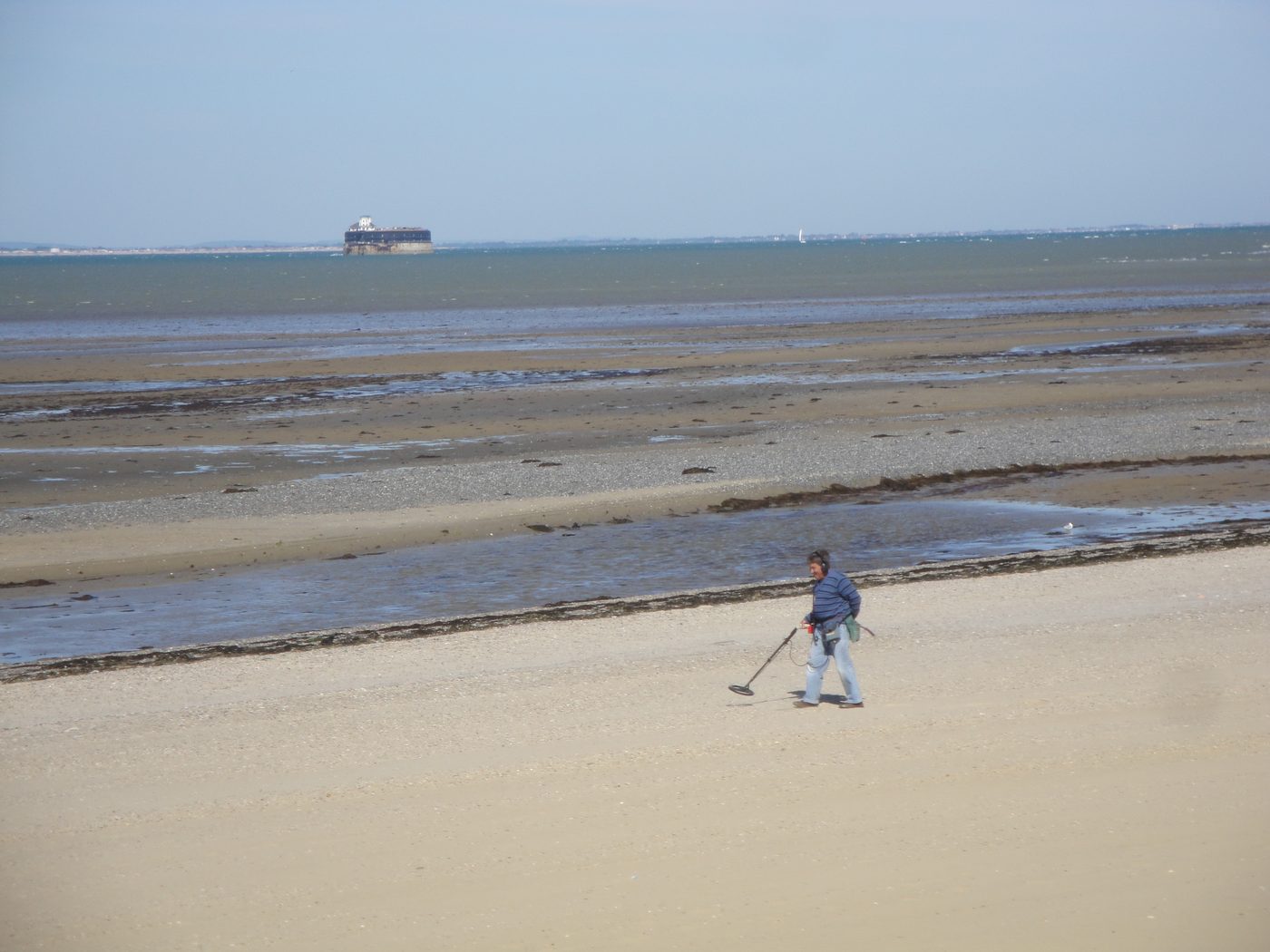
Short answer
You can metal detect on Crown Estate foreshore, the land between mean high water and mean low water, without a formal consent from The Crown Estate, but that permissive right is granted "strictly subject to the Terms and Conditions and any third party right(s)". Those Terms and Conditions, dated 22/01/2024, require surface investigation only with no excavation into the hard pack sub-surface, no mechanical tools, every hole refilled "however small or shallow", treasure reported to the Coroner's Court within fourteen days with evidence supplied to The Crown Estate, and items of value reported to The Crown Estate and the Police within fourteen days. Clause 5 states that The Crown Estate "reserves their right to ownership of all or any objects found", so the popular line that beach finds are automatically yours is not what the document says. Before any beach, check three layers: Crown Estate ownership, any SSSI or Marine Conservation Zone, and any council byelaw or permit scheme.
Almost every page about metal detecting on UK beaches says the same thing in the same sentence: the Crown Estate owns foreshore, and it lets detectorists on without a permit. That is true, and it is about a fifth of the story, because the permission is granted on terms, the terms are published, and the terms are stricter than the hobby consensus.
This guide reads that document, sets out the repeatable three-layer check to run on any beach before you travel, and answers the question the folk wisdom gets wrong, which is who owns what you find.
On the coast for gold rather than coins and jewellery? The UK Gold Prospector map plots 300 plus gold panning and prospecting sites across the UK.
Open the live map →Can you metal detect on UK beaches without permission?
On Crown Estate foreshore in England, Wales and Northern Ireland you do not have to apply for anything first. The Crown Estate grants a standing permissive right and states it plainly.
"Anybody wishing to carry out metal detecting on Crown Estate foreshore (defined as the land between mean high water and mean low water) may do so without a formal consent from The Crown Estate, however this is strictly subject to the Terms and Conditions and any third party right(s) as indicated under section 2 of the Terms and Conditions."
Most beach guides stop at the first half of that sentence. The second half decides what the permission consists of: it is "strictly subject to the Terms and Conditions" and to "any third party right(s) as indicated under section 2". Section 2 is where the Crown Estate itself tells you that other bodies can close the beach to you. So this is a check you run, not a list of beaches you trust.
The same page sets the outer edge of the right, and it is narrower than "Crown land" suggests.
"This permissive right applies to Crown Estate foreshore only and not to the seabed, river beds, or any other Crown Estate land."
Foreshore is a tide-defined strip, not "the beach" as a visitor sees it. Above mean high water you are usually on somebody else's land, and below mean low water you are on the seabed, which the right does not reach. Reaching the strip is a separate permission again, because clause 9 makes any adjoining land owner's consent your responsibility to obtain.
What the Crown Estate Terms and Conditions dated 22/01/2024 actually say
The Terms and Conditions are a separate PDF dated 22/01/2024, linked from the Crown Estate's metal detecting and drone flying page. Almost nothing written about beach detecting quotes them. Here is the whole document as an index; the sections below take the important clauses in full.
| Clause | What it covers | The line that matters |
|---|---|---|
| 1 | How far the consent reaches | Foreshore only, "not to any part of the bed of the sea" |
| 2 | Third party rights | Lessees and licensees "may restrict metal detecting"; in an SSSI or Marine Conservation Zone "the relevant authority may object"; local authorities can ban it "through the use of byelaws" |
| 3(ii) | Digging | Surface only, and "not excavate into the hard pack sub-surface" |
| 3(iii) | Tools | "No mechanical tool, plant or equipment may be used for excavation" |
| 3(iv) | Holes | Any hole "(however small or shallow) must be refilled" |
| 4(i) to 4(v) | Reporting duties | Archaeological finds to the Portable Antiquities Scheme; treasure, items of value and Wreck each on a fourteen day clock, set out in full below |
| 5 | Ownership of finds | "The Crown Estate reserves their right to ownership of all or any objects found" |
| 7 | Withdrawal | Access may be restricted or prohibited "at any time without notice" |
| 9 | Getting there | Other permissions, including those of adjoining land owners, are your responsibility |
Primary source: Terms and Conditions of metal detecting (PDF, dated 22/01/2024), linked from the Crown Estate metal detecting and drone flying page.
How deep are you allowed to dig on a Crown Estate beach?
This is the clause most beach detectorists have never read, and it is the one that changes behaviour.
"You may only investigate the surface of the foreshore and not excavate into the hard pack sub-surface of the foreshore to ensure that the archaeological integrity of any embedded find is retained."
Source: The Crown Estate, Terms and Conditions, clause 3(ii)
Read that with clause 3(iii), "No mechanical tool, plant or equipment may be used for excavation", and clause 3(iv), "Any hole (however small or shallow) must be refilled so that the foreshore is reinstated to its condition before digging or excavation was commenced by the applicant so as not to create a hazard to other foreshore users." Together they describe one style of beach detecting: surface recovery, by hand, ground reinstated every time. The words "however small or shallow" are in the document, and they remove the argument that a small scrape does not count. Clause 7 adds that access can be restricted or prohibited "at any time without notice".
Who owns what you find on a Crown Estate beach?
The most repeated line in beach detecting content is that whatever you pull out of the sand is yours. This is the part the popular guides get wrong, so it needs quoting rather than summarising.
"The Crown Estate reserves their right to ownership of all or any objects found, and the granting of this permission does not transfer any such rights to you. You may not claim ownership or rights to any objects found on the foreshore by virtue of this consent."
Say exactly what that is and nothing more. It is a contractual term of the permissive right you are relying on, not a criminal provision, and it makes the point twice: as a reservation of the Crown Estate's rights, and as a restriction on what you may claim by virtue of the consent. So the widely repeated line that anything you find on a Crown Estate beach is yours to keep is not what the Terms and Conditions say. The document does not describe how the reservation is applied in practice, and this page will not guess. What it does set out is an equal division: monies on items of value under clause 4(iii), and a treasure reward under clause 4(ii), "generally this will be in equal shares".
The Crown Estate's public page adds a general statement about the same ground, worth reading alongside clause 5 rather than instead of it.
"Finds above the low water mark are generally the property of the landowner, unless classified as Treasure. Wreck found on the seabed may still legally belong to a third party, therefore we recommend that any finds, particularly whilst you are diving or snorkelling, are not removed and are reported to Historic England and the Receiver of Wreck."
On Crown Estate foreshore, the landowner in that sentence is The Crown Estate. Above mean high water it is whoever owns the dry sand or the promenade, so one outing can cross two ownership positions within a few metres. The Portable Antiquities Scheme adds the practical fix: any finds "will normally be the property of the landowner, so to avoid disputes it is advisable to get permission and agreement in writing first regarding the ownership of any finds subsequently discovered" (Code of Practice for Responsible Metal Detecting). The New Forest National Park Authority puts the principle in one line: "Under UK law there is no such thing as 'finders keepers'." (New Forest National Park Authority)
What you have to report on a beach, and by when
Clause 4 is where the reporting duties live, and the deadline is the same on nearly all of them.
| What you find | Who the documents say to tell | Deadline | What happens next |
|---|---|---|---|
| Any archaeological find | Portable Antiquities Scheme (clause 4(i)) | Not specified | The Code of Practice for Responsible Metal Detecting applies at all times |
| Anything likely to be treasure | The coroner under section 8 of the Treasure Act 1996, the Coroner's Court under clause 4(ii), plus evidence supplied to The Crown Estate | Fourteen days | Reward apportioned, "generally this will be in equal shares" |
| An item of value such as jewellery and coins, excluding individual or small quantities of modern coins | The Crown Estate and the Police (clause 4(iii)) | Fourteen days | Monies "divided equally between The Crown Estate and the applicant (after the deduction of any costs)" |
| Anything likely to be Wreck | The Receiver of Wreck and The Crown Estate (clause 4(v)) | 14 days | Merchant Shipping Act 1995 applies |
| An item of value found in Northern Ireland | The Crown Estate, the Police and the Director of the Ulster Museum (clause 4(iv)) | 14 days | Treated under the Historic Monuments Act (Northern Ireland) 1971 |
Source for all clauses: Terms and Conditions of metal detecting (PDF, dated 22/01/2024).
The treasure duty is statutory and applies whoever owns the beach. Section 8 of the Treasure Act 1996 requires anyone who finds an object they believe, or have reasonable grounds for believing, is treasure to notify the coroner for the district before the end of the notice period, which section 8(2) sets at fourteen days. Section 8(3) makes failure to comply an offence punishable on summary conviction by "imprisonment for a term not exceeding three months", a fine not exceeding level 5 on the standard scale, or both, with a defence of reasonable excuse at section 8(4) (Treasure Act 1996, section 8). So a likely treasure find on Crown Estate foreshore carries two duties inside the same fourteen days: notify the coroner, then show the Crown Estate you did.
The three-layer check to run on any beach
Clause 2 is why this check has three layers rather than one: the Crown Estate points beyond its own permission, to designations and to councils. There is an ownership map and you should use it, but it answers one of the three questions.
| Layer | Question it answers | Where to check | What it can do to your trip |
|---|---|---|---|
| 1. Ownership | Is this Crown Estate foreshore, between mean high water and mean low water? | The Foreshore and Estuary Ownership Map | If it is not, the permissive right does not apply and you need the actual landowner |
| 2. Designation | Is it an SSSI or a Marine Conservation Zone? | MAGIC GIS, the free Defra mapping at magic.defra.gov.uk | The relevant authority "may object to certain activities, and so access may be restricted" (clause 2) |
| 3. Byelaw or permit | Has the council banned it, or does it run a permit scheme? | The council's own metal detecting or byelaws page | Local authorities "have the power to ban metal detecting and other activities through the use of byelaws" (clause 2) |
Layer 1: is it actually Crown Estate foreshore?
The Crown Estate directs users to its Foreshore and Estuary Ownership Map to find out which areas of foreshore it owns. The viewer is hosted on arcgis.com and linked from its metal detecting page. If your beach is not on it, the permissive right does not apply there and you are back to identifying the actual landowner. Clause 1 puts the same limit in contractual language: the consent "extends only to the foreshore only and not to any part of the bed of the sea". This page does not state what share of the UK coastline the Crown Estate owns, because that figure could not be verified from a Crown Estate source.
Layer 2: is there an SSSI or a Marine Conservation Zone?
This is the layer that turns a legally owned beach into one you cannot detect on, and the Crown Estate flags it under clause 2. Where the foreshore lies within an SSSI or a Marine Conservation Zone, the Terms and Conditions state that "the relevant authority may object to certain activities, and so access may be restricted", naming Natural England, Natural Resources Wales or the Northern Ireland Environment Agency. Read that carefully: a designation is a trigger to check, not a verdict on its own.
The clearest published example of clause 2 biting is the New Forest, where an SSSI sits directly on top of Crown Estate foreshore.
"Metal detecting is not allowed on Sites of Special Scientific Interest (SSSI) without permission. Most of the New Forest National Park has this designation... and most of the Crown Estate-owned foreshore within the National Park is also designated under separate SSSIs."
Source: New Forest National Park Authority, checked 2026-09-10
That is a public authority stating that Crown Estate foreshore inside its area carries a separate SSSI designation on top of the ownership. The ownership map shows you layer one and nothing about layer two. The same page gives the route through it, Natural England on 0300 060 3900 or enquiries@naturalengland.org.uk, and names the checking tool: "relevant designations can be checked using online free mapping called MAGIC GIS." That is the free Defra mapping at magic.defra.gov.uk, and GOV.UK publishes guidance on Sites of Special Scientific Interest.
Councils act on it too: Arun excludes West Beach at Littlehampton as an SSSI, North East Lincolnshire's consent scheme exists because the Humber Estuary is one, and Sefton splits its coast between the open beach and the dune system. Check where on the beach the designation sits.
Layer 3: what do councils actually do on beaches?
The third layer exists because the Crown Estate says it does: the body granting the permissive right recommends you check with somebody else before relying on it.
"Local authorities also have the power to ban metal detecting and other activities through the use of byelaws and we would therefore recommend checking with the appropriate authority to ensure that no such ban is in place."
There is no national register of which councils allow metal detecting, so nobody can hand you a complete list. The authorities below were each read individually on 2026-09-10. Treat them as a verified sample, not a survey.
| Authority | Position | Their own words | Source, checked 2026-09-10 |
|---|---|---|---|
| Cornwall Council | Allowed on Council owned beaches, no permit | "Metal detecting is permitted on Council owned beaches... You do not need a permit to do this." But "not permitted on beaches which have an SSSI attached to them" | Cornwall Council |
| Arun District Council | No permit on beaches, free annual permit for other council land | "You do not need a permit to detect on our beaches as any damage caused by digging is minimal." West Beach, Littlehampton is excluded as an SSSI | Arun District Council |
| North East Lincolnshire Council | Per-day prior consent for Cleethorpes Beach | Consents "valid for a single day"; going without "may result in a Fixed Penalty Notice (FPN) Fine of £100 in accordance with the Public Space Protection Order" | North East Lincolnshire Council |
| Sefton Council | Allowed on parts of the beach, not in the dunes | "You are allowed to metal detect on the beach in certain areas (seashore bylaw 9b) NOT in the dune system this is a SSSI protected site (sandhill bylaw 11)" | Sefton Council |
| Dorset Council | Not permitted on council land, research only | "Archaeological fieldwork and metal detecting are not permitted on land owned or managed by Dorset Council unless it is part of an approved programme of archaeological investigation or research" | Dorset Council |
| BCP Council | Not permitted in parks, gardens or nature reserves | "We do not allow anyone to use metal detectors in our parks, gardens or nature reserves." Byelaw breaches carry a fine "up to a maximum of £500" | BCP Council |
| New Forest District, Hampshire County and Wiltshire councils | Not permitted, or not without permission | Detecting is "not permitted on New Forest District Council land", "not allowed on Hampshire County Council land without permission" and "not permitted on Wiltshire Council land" | New Forest National Park Authority |
Three cautions. Cornwall Council's page names 30 beaches but carries no last-reviewed date, so this is the position read on 2026-09-10, not a guarantee that it is current. The BCP wording covers parks, gardens and nature reserves, and that byelaws page states no beach position either way. And the New Forest District, Hampshire and Wiltshire rows are quoted as the New Forest National Park Authority states them, not from those councils directly.
One English coastline can carry four different regimes within a few counties of each other: no permit at all, a free membership-gated permit, a fresh consent for every single day backed by a fixed penalty, and a flat ban with a research exception. That is why this layer is checked beach by beach. The four policy patterns, the wider verified sample and a method for checking your own authority are in our guide to councils that allow metal detecting.
Can you metal detect on the Thames foreshore?
Not on the Crown Estate permissive right alone. The Thames has its own permit scheme, and the Crown Estate is a party to it rather than absent from it: its own terms state that "In respect of the River Thames foreshore only, we jointly administer a permit scheme with the Port of London authority."
"Metal detecting and mud-larking on the River Thames foreshore requires a separate permit from the Port of London Authority."
The Terms and Conditions add why: "Due to the sensitive archaeological nature of the Thames, foreshore searching (mud-larking) is banned or subject to additional restrictions in a number of locations." Permits come from the Port of London Authority.
The Thames stacks all three layers at once: ownership fails, because river beds are expressly outside the permissive right; designation appears as the archaeological sensitivity described above; and the permit scheme is jointly administered by the Crown Estate and the Port of London Authority rather than by a council. Anyone who checked only the ownership map would get this one wrong.
Why are Scottish beaches different?
On a Scottish beach the Crown Estate page you have just read does not govern you. Crown Estate Scotland is a separate body, and it states the contrast itself.
"In Scotland (in contrast to England, Wales and Northern Ireland), there is a general right of access for the public to all beaches and foreshore, so we don't require people to obtain a permit for access to Crown foreshore."
That does not carry the rest of the English framework with it. The same page states that "It is a criminal offence to use a metal detector on a scheduled monument without written permission from Scottish Ministers beforehand", and that "Detectorists should abide by the statutory treasure trove procedures". It also carries a buried power cable warning aimed at beaches: look for cable marker posts, avoid digging where a detector reads across a large length, and if a cable is exposed, do not go near it and report it on 105.
Scottish finds law is a separate system, and it is far wider than the Treasure Act.
"Under Scottish law all portable antiquities of archaeological, historical or cultural significance are subject to claim by the Crown through the Treasure Trove system and must be reported."
In England, Wales and Northern Ireland the Treasure Act catches a defined class of object and everything else is normally the landowner's. In Scotland the Crown can claim any portable antiquity of archaeological, historical or cultural significance, whatever it is made of, and reporting is a legal obligation. The full picture is in our guide to metal detecting laws in Scotland.
What this page does not tell you
Three deliberate gaps, because being straight about them is more useful than filling them with a guess.
- We do not state what share of the UK coastline the Crown Estate owns. That figure is common in hobby guides but was not verified from a Crown Estate source. Use the Foreshore and Estuary Ownership Map for the beach you intend to visit.
- We do not quote the National Council for Metal Detecting's Code of Conduct. Its site could not be read from source on 2026-09-10, so no sentence of it appears here. What is safe to say, because Arun District Council says it, is that Arun issues its free council-land permit to members of a national metal detecting organisation.
- We do not claim the Cornwall Council beach list is up to date. It was read live on 2026-09-10 and the page carries no last-reviewed date.
The beach check, as a routine
- Ownership. Find the beach on the Foreshore and Estuary Ownership Map, confirm it is foreshore rather than seabed, river bed or other Crown Estate land, then work out how you will reach it, because clause 9 makes access over adjoining land your responsibility.
- Designation. Check whether the beach, or part of it, is an SSSI or a Marine Conservation Zone on MAGIC GIS. If it is, treat clause 2 as a prompt to ask Natural England, Natural Resources Wales or the Northern Ireland Environment Agency.
- Byelaw or permit. Find the council's own metal detecting or byelaws page, work out which pattern it follows, and obtain any consent before you travel.
- On the day. Surface only, no mechanical tools, every hole refilled however small, and the clause 4 reporting duties on a fourteen day clock.
Inland the same discipline applies, landowner question first and designation stack on top. That is our main guide to where you can legally metal detect in the UK. If you are on the coast for gold rather than beach finds, panned gold sits under a different regime again: every site we have mapped is on the UK Gold Prospector map, and our free beginner's prospecting pack covers where to start.
Frequently Asked Questions
Which beaches can you metal detect on without permission in the UK?
Crown Estate foreshore in England, Wales and Northern Ireland, which the Crown Estate defines as "the land between mean high water and mean low water". Detecting there needs no formal consent, but the Crown Estate grants it "strictly subject to the Terms and Conditions and any third party right(s)". That is an ownership category, not a list of named beaches. Check the Foreshore and Estuary Ownership Map first, then for an SSSI or Marine Conservation Zone, then the council.
Can you metal detect on Crown Estate beaches?
Yes, on Crown Estate foreshore, without applying for a permit. The Crown Estate states that anybody wishing to detect on its foreshore "may do so without a formal consent from The Crown Estate, however this is strictly subject to the Terms and Conditions". Those Terms and Conditions are dated 22/01/2024 and set conditions covering digging depth, tools, refilling holes, reporting deadlines and ownership of objects found.
Can you metal detect on Crown Land?
Not on the strength of the foreshore permission. The Crown Estate is explicit that "This permissive right applies to Crown Estate foreshore only and not to the seabed, river beds, or any other Crown Estate land." Other Crown Estate land has to be treated as ordinary landowner permission. Clause 9 also makes you responsible for any permission needed from adjoining landowners in order to reach the foreshore.
Is there a Crown Estate metal detecting map?
The Crown Estate directs users to its Foreshore and Estuary Ownership Map to find out which areas of foreshore it owns. It is a map viewer hosted on arcgis.com and linked from the Crown Estate's metal detecting and drone flying page. It answers the ownership question only. It does not show SSSI or Marine Conservation Zone designations, and it does not show council byelaws or permit schemes, both of which the Crown Estate tells you to check separately.
Do you need a permit to metal detect on a beach in the UK?
Not from the Crown Estate on its foreshore. You may need one from the council. North East Lincolnshire Council requires a fresh prior consent for each day on Cleethorpes Beach and warns that going without "may result in a Fixed Penalty Notice (FPN) Fine of £100 in accordance with the Public Space Protection Order". Arun District Council, by contrast, states "You do not need a permit to detect on our beaches". The tidal Thames needs a separate Port of London Authority permit.
Where can I metal detect in the UK for free?
Crown Estate foreshore carries no fee and no application. Cornwall Council states "Metal detecting is permitted on Council owned beaches. There is a list of these below. You do not need a permit to do this." Arun District Council issues permits for its other land that are "free of charge and last for one year" to members of a national metal detecting organisation. Free does not mean unconditional: the Crown Estate Terms and Conditions still apply.
Can you use a metal detector on any beach?
No. Clause 2 of the Crown Estate Terms and Conditions warns that lessees and licensees "may restrict metal detecting on Crown Estate land", that where an SSSI or Marine Conservation Zone applies "access may be restricted", and that "Local authorities also have the power to ban metal detecting and other activities through the use of byelaws". Sefton Council, for example, allows detecting on certain beach areas but not in the dune system, which is an SSSI protected site.
Can I keep what I find on a Crown Estate beach?
The Terms and Conditions do not say that you can. Clause 5 states: "The Crown Estate reserves their right to ownership of all or any objects found, and the granting of this permission does not transfer any such rights to you." Clause 4(iii) requires items of value such as jewellery and coins, excluding individual or small quantities of modern coins, to be reported to The Crown Estate and the Police within fourteen days, with any monies divided equally.
What should I do if I find jewellery on the beach?
Clause 4(iii) of the Crown Estate's Terms and Conditions requires any item of value such as jewellery and coins, excluding individual or small quantities of modern coins, to be reported to The Crown Estate and the Police within fourteen days. Value is agreed, or valued by at least two persons, or set by sale, and "Any monies received shall be divided equally between The Crown Estate and the applicant (after the deduction of any costs)."
What are the laws on metal detecting on UK beaches?
Two things run in parallel. The Crown Estate's permissive right and its Terms and Conditions dated 22/01/2024 are contractual, covering surface-only searching, no mechanical tools, refilling every hole "however small or shallow", the clause 4 reporting duties and the clause 5 reservation of ownership. Statute sits on top: section 8 of the Treasure Act 1996 requires the coroner to be notified about likely treasure within fourteen days.
Is it worth metal detecting on a beach?
This page is about where you are allowed to detect rather than what is in the ground, and it makes no claims about which beaches produce finds. On the permission question, Crown Estate foreshore requires no application, provided the surface-only, refill-every-hole and fourteen day reporting conditions are met. On ownership, clause 5 reserves the Crown Estate's rights and items of value carry an equal split.
Do the same rules apply on Scottish beaches?
No. Crown Estate Scotland states: "In Scotland (in contrast to England, Wales and Northern Ireland), there is a general right of access for the public to all beaches and foreshore, so we don't require people to obtain a permit for access to Crown foreshore." Reporting is wider too: Treasure Trove Scotland states that all portable antiquities of archaeological, historical or cultural significance are subject to claim by the Crown and "must be reported".
Know where you are allowed to search, then find somewhere worth searching. The interactive map covers 300 plus UK gold panning and prospecting sites.
Open the Interactive Map →New to this? The free beginner's pack covers the legal basics, how to read a river, and how to start without wasting a season.
Get the Free Pack →